
AE-7 Map – 11 Audios – AE-7 Model – 33 Cases – 105 Cases – Book I
Version en español (castellano) >>>
33 PETER CRONE CASES ANALYZED THROUGH THE AE-7 MODEL AND FAMILY CONSTELLATIONS & PERSONAL CONSTELLATIONS
From the Intervention to Emotional Architecture
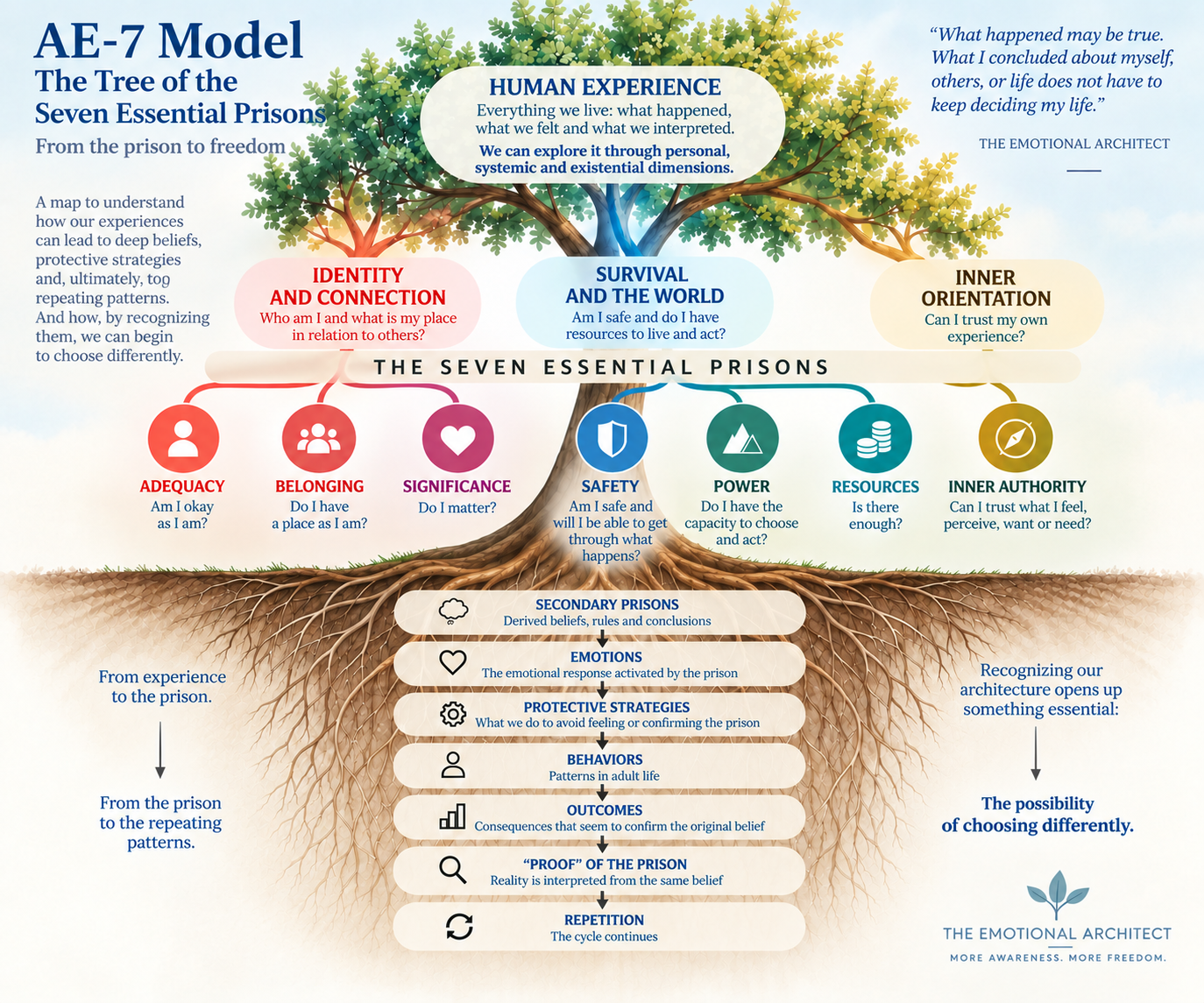
This collection brings together public excerpts from interventions by Peter Crone and analyzes them through the perspective of the AE-7 Model — The Tree of the Seven Essential Prisons.
🎧 DO YOU PREFER TO LISTEN?
You can listen to all four chapters in sequence or simply choose the one that interests you most.
Audio 1 — Peter Crone and the AE-7 Model
Audio 2 — Beyond Psychological Interpretation
Audio 3 — The Cases
Audio 4 — Three Perspectives. One Human Experience
3 FREE-ACCESS CASES TO UNDERSTAND THE AE-7 MODEL
Examples of testimonials translated from Spanish >>>
PC-7 — “It Is All Up to Me”
PC-11 — “I Am Not Enough”
PC-32 — “To Be Safe, I Cannot Upset Others”
Peter Crone has a remarkable ability to identify the unconscious beliefs that may be organizing a person’s experience. In many of his interventions, he begins with a present-day problem, emotion, or behavior and gradually moves deeper until a more fundamental conclusion about oneself, other people, or life becomes visible.
Without a doubt, he is one of the great teachers of our time, comparable to masters of the present moment such as Mooji or Eckhart Tolle. His work goes beyond simply identifying psychological patterns; it invites us to recognize the limitations through which we experience ourselves and life, opening the possibility of greater freedom.
Peter Crone and AE-7 explore similar territory, but they organize the process differently.
The AE-7 Model uses these interventions as cases for observation and learning. Through them, we can study how an experience acquires meaning, how that meaning may become an emotional prison, and how we develop strategies designed to protect ourselves, obtain what we believe we are missing, or avoid what we fear experiencing again.
The process we explore is:
EXPERIENCE
↓
MEANING
↓
ESSENTIAL PRISON
↓
DERIVED PRISON
↓
EMOTION
↓
PROTECTIVE STRATEGY
↓
BEHAVIOR / ADAPTIVE PERSONALITY
↓
OUTCOME
↓
“PROOF” OF THE ORIGINAL BELIEF
↓
REPETITION
And, especially, we observe the point at which this architecture can begin to break:
SEE → DIFFERENTIATE → QUESTION → FEEL → RECLAIM THE CAPACITY TO CHOOSE → ACT DIFFERENTLY → CREATE A NEW EXPERIENCE
Peter Crone and the AE-7 Model
Peter Crone’s work is the primary inspiration behind the AE-7 Model, particularly his way of investigating unconscious beliefs and revealing how conclusions formed in the past may continue to shape our present experience.
The AE-7 Model, however, proposes its own architecture for organizing and deepening this investigation through Seven Essential Prisons:
Adequacy · Belonging · Significance · Safety · Power · Resources · Inner Authority
Each case attempts to answer a fundamental question:
WHAT WOULD HAVE TO BE TRUE FOR THIS STRATEGY TO MAKE SENSE?
And from there, we continue moving deeper:
What is the person trying to obtain or avoid?
What would it mean to them if that happened?
What deeper conclusion seems to be organizing their experience?
Which of the seven essential roots does it lead us to?
Beyond Psychological Interpretation
Peter Crone’s work is not limited to investigating unconscious beliefs. In some of his interventions, he also introduces an existential and spiritual dimension, viewing human experience as an opportunity to recognize and transcend our limitations and move toward greater inner freedom.
Within this context, he also uses concepts such as energy, vibration, and frequency, and proposes possible relationships between our internal states and our physical experience.
AE-7 does not need to adopt or reject these interpretations in order to do its work.
Its starting point is more concrete: observing what the person experiences, what meaning that experience acquires, what conclusion may be formed, and how that conclusion continues to organize emotions, protective strategies, and behaviors.
This allows us to distinguish three levels that may coexist without needing to be confused:
PERSONAL EXPERIENCE
What did I experience, what meaning did it acquire, and what did I conclude from it?
↓
SYSTEMIC EXPERIENCE
What may emerge when we broaden our perspective and observe the person within the family system to which they belong?
↓
EXISTENTIAL OR SPIRITUAL DIMENSION
What broader meaning might this experience acquire within my life and my path toward greater freedom?
AE-7 does not attempt to determine whether we chose our experiences before birth, what the purpose of a soul might be, or what the ultimate nature of reality is.
These possibilities may be part of each person’s spiritual worldview, but they are not necessary in order to investigate and transform our Emotional Architecture.
WE DO NOT NEED TO KNOW WHY LIFE PRESENTED US WITH AN EXPERIENCE IN ORDER TO DISCOVER WHAT IT MAY BE REVEALING AND WHAT POSSIBILITY OF FREEDOM IT MAY OPEN.
TWO COMPLEMENTARY PERSPECTIVES
The AE-7 Model helps us investigate what emotional architecture may be shaping an experience: what happened, what meaning it acquired for the person, what conclusion may have been formed, and what strategies may have developed from it.
But we can broaden our perspective in two different and complementary directions:
TOWARD THE SYSTEM WE BELONG TO.
and
TOWARD THE DIFFERENT STAGES OF OUR OWN BIOGRAPHY.
From this emerge two complementary explorations of some AE-7 cases:
A — FAMILY CONSTELLATIONS
B — PERSONAL CONSTELLATIONS
We are not trying to demonstrate that any of these perspectives contains the definitive explanation.
Each one opens a different space for observation.
FIRST EXPANSION OF THE PERSPECTIVE: FAMILY CONSTELLATIONS
In certain cases, we add a complementary page identified by the letter A:
PC-7-En → PC-7-A-En
PC-11-En → PC-11-A-En
PC-32-En → PC-32-A-En
These pages explore the same case from the systemic perspective of Family Constellations.
The question changes.
AE-7 primarily explores:
WHAT EMOTIONAL ARCHITECTURE IS SHAPING MY EXPERIENCE?
Family Constellations broaden the observation toward another question:
WHAT EMERGES WHEN I OBSERVE MYSELF IN RELATION TO MY SYSTEM?
During a Constellation, representatives may experience bodily sensations, emotions, impulses, orientations, or movements that do not arise from conscious knowledge of the history of the people they represent.
This phenomenon has received different interpretations and may be described through concepts such as field, resonance, systemic information, or energetic connection.
AE-7 does not need to establish the mechanism that produces this experience.
In Constellation work, we take a phenomenological position: we observe what emerges and work with it, without needing to turn any particular psychological, systemic, energetic, or spiritual explanation into a predetermined truth.
We therefore do not assume that an emotional prison necessarily originates with the father, the mother, or a family or transgenerational dynamic.
We may begin with a simple configuration—usually the person, the father, and the mother—and observe.
If, during the process, it becomes necessary to introduce other family members, events, or significant elements, we can do so progressively.
WE PLACE → WE OBSERVE → WE MAKE A MOVEMENT → WE OBSERVE AGAIN → WE ADD ONLY WHAT IS NECESSARY
The PC-xxx-A pages are not intended to tell us in advance what a case means systemically.
They explore different paths a Constellation might take depending on what emerges during the process.
WE DO NOT SEEK TO MAKE THE SYSTEM CONFIRM OUR INTERPRETATION.
WE BEGIN WITH A SIMPLE IMAGE AND WORK WITH WHAT GRADUALLY EMERGES.
SECOND EXPANSION OF THE PERSPECTIVE: PERSONAL CONSTELLATIONS
There is also another possible direction.
Instead of broadening our perspective toward the family system, we can turn it toward the different stages of our own biography.
These explorations are identified by the letter B:
PC-7-En → PC-7-B-En
PC-11-En → PC-11-B-En
PC-32-En → PC-32-B-En
Here, the question changes again:
WHAT EMERGES WHEN I OBSERVE MY DIFFERENT AGES AND THE RELATIONSHIP BETWEEN THEM?
A Personal Constellation can allow us to observe how different stages of our lives may participate in a present experience.
But we do not begin with the assumption that we already know which age contains the problem.
We do not automatically look for a “wounded child.”
We do not attribute thoughts, emotions, or intentions to any representative in advance.
First, we observe the phenomenon.
We observe the distances.
The orientations.
The gazes.
Closeness or rejection.
The movements.
Who seeks whom.
Who avoids whom.
Who tries to protect, control, or move away.
Then we listen to what sensation or emotion emerges in each representative.
And only then, if necessary, do we look for words that might express what is emerging.
A phrase is not introduced because we have decided in advance that it represents the truth of that stage of the person’s life.
It can be offered as a possibility:
“If that experience were present, perhaps it could be expressed as…”
And we observe what happens.
Each phrase is a proposal.
The representative’s response guides us as to whether it makes sense to continue in that direction.
The process may gradually allow us to:
RECOGNIZE
↓
DIFFERENTIATE
↓
LISTEN
↓
UPDATE
↓
INTEGRATE
The aim is not to eliminate an earlier stage of our life, nor to make one “correct” part defeat another.
It is to explore whether we can establish a different relationship with our own experience and regain a greater capacity for choice in the present.
THREE CASES, THREE WAYS OF LOOKING
The cases PC-7-En, PC-11-En, and PC-32-En allow us to observe these three perspectives with particular clarity.
PC-7-En — “EVERYTHING DEPENDS ON ME”
PC-7-En — The investigation through the AE-7 Model
PC-7-A-En — The perspective of Family Constellations
PC-7-B-En — The perspective of Personal Constellations
PC-11-En — “I AM NOT ENOUGH”
PC-11-En — The investigation through the AE-7 Model
PC-11-A-En — The perspective of Family Constellations
PC-11-B-En — The perspective of Personal Constellations
PC-32-En — “TO BE SAFE, I CANNOT UPSET OTHERS”
PC-32-En — The investigation through the AE-7 Model
PC-32-A-En — The perspective of Family Constellations
PC-32-B-En — The perspective of Personal Constellations
These are not three explanations competing with one another.
They are three different places from which to observe the same experience.
THREE PERSPECTIVES ON THE SAME EXPERIENCE
AE-7 MODEL
WHAT EMOTIONAL ARCHITECTURE IS SHAPING MY EXPERIENCE?
FAMILY CONSTELLATIONS
WHAT EMERGES WHEN I OBSERVE MYSELF IN RELATION TO MY SYSTEM?
PERSONAL CONSTELLATIONS
WHAT EMERGES WHEN I OBSERVE MY DIFFERENT AGES AND THE RELATIONSHIP BETWEEN THEM?
AN IMPORTANT DISTINCTION
This collection does not attribute the AE-7 Model or the analyses from Family Constellations or Personal Constellations to Peter Crone, nor does it intend to present these interpretations as having been made or approved by him.
Peter Crone is the source of the interventions in the original videos.
The subsequent interpretations, their classification within the Seven Essential Prisons, the concepts of essential and derived prisons, the architecture used to organize them, and the specific AE-7 terminology belong to the AE-7 Emotional Architecture Model.
Likewise:
The PC-xxx-A pages constitute a subsequent and complementary exploration through Family Constellations.
The PC-xxx-B pages constitute a subsequent and complementary exploration through Personal Constellations.
We will always distinguish between:
WHAT OCCURS IN PETER CRONE’S ORIGINAL INTERVENTION
and
THE SUBSEQUENT INTERPRETATION WE DEVELOP THROUGH AE-7 AND, WHEN APPROPRIATE, THROUGH FAMILY CONSTELLATIONS OR PERSONAL CONSTELLATIONS.
The same behavior can arise from different emotional roots.
The same strategy can attempt to resolve different prisons.
A significant family history does not, by itself, demonstrate a systemic or transgenerational cause.
And a present experience does not allow us to determine in advance which stage of our biography may be participating in it.
The model is not intended to impose an explanation on the person.
It is intended to help us observe more deeply and formulate better questions.
THE MAP POINTS THE WAY.
THE PERSON REVEALS THE MEANING.
FREE ACCESS CASES
To explore the Emotional Architect method in depth, we have selected three complete cases with free access, no access code required.
Each case offers two complementary perspectives:
1. AE-7 Model — Case analysis and reverse engineering to identify the emotional prison, its underlying root, and the protective strategies built around it.
2. Family Constellations — An exploration of the same case from a systemic and phenomenological perspective.
PC-7-En — “It’s All Up to Me”
When taking responsibility, solving problems, and carrying everything becomes a strategy for feeling safe.
→ CASE ANALYSIS — PC-7-En
https://arquitectoemocional.com/pc-7-en
→ FAMILY CONSTELLATIONS — PC-7-A-En
https://arquitectoemocional.com/pc-7-a-en
→ PERSONAL CONSTELLATIONS — PC-7-B-En
https://arquitectoemocional.com/pc-7-b-en
PC-11-En — “I’m Not Enough”
Self-demand, perfectionism, and the “shoulds” that arise when we feel we need to prove our worth.
→ CASE ANALYSIS — PC-11-En
https://arquitectoemocional.com/pc-11-en
→ FAMILY CONSTELLATIONS — PC-11-A-En
https://arquitectoemocional.com/pc-11-a-en
→ PERSONAL CONSTELLATIONS — PC-11-B-En
https://arquitectoemocional.com/pc-11-b-en
PC-32 — “To Be Safe, I Can’t Upset Others”
When pleasing others, adapting, and keeping the peace become ways of protecting our sense of safety and our relationships.
→ CASE ANALYSIS — PC-32-En
https://arquitectoemocional.com/pc-32-en
→ FAMILY CONSTELLATIONS — PC-32-A-En
https://arquitectoemocional.com/pc-32-a-en
→ PERSONAL CONSTELLATIONS — PC-32-B-En
https://arquitectoemocional.com/pc-32-b-en
These three examples allow you to follow the complete process:
CASE → EMOTIONAL PRISON → ROOT → STRATEGIES → AE-7 REVERSE ENGINEERING → FAMILY CONSTELLATIONS
DIRECTORY OF CASES
The following cases are part of the complete Emotional Architect collection and require an access code.
PC-003-En — “There Is Something Wrong With Me” – Access Code Required.
When hiding to stay safe ends up hiding you from life.
Main roots: Adequacy · Safety · Associated root: Belonging
EXTENSION — FAMILY CONSTELLATIONS – Access Code Required.
PC-003-A-En — “There Is Something Wrong With Me” Through Family Constellations
A systemic exploration of family, belonging, responsibility, money, and different movements that might emerge in a Constellation.
PC-004-En — “They Don’t Love Me” – Access Code Required.
When the fear that there is something wrong with me becomes the fear of being abandoned.
Main root: Belonging · Associated root: Adequacy
EXTENSION — FAMILY CONSTELLATIONS – Access Code Required.
PC-004-A-En — “They Don’t Love Me” Through Family Constellations
A systemic exploration of parental bonds, belonging, maternal history, and later generations.
PC-006-En — “I Don’t Matter” – Access Code Required.
When we learn to disappear so we won’t be a burden.
Main root: Significance · Associated root: Belonging
EXTENSION — FAMILY CONSTELLATIONS – Access Code Required.
PC-006-A-En — “I Don’t Matter” Through Family Constellations
A systemic exploration of the daughter’s place, the deceased brother, the parents’ grief, and the right to occupy her own place.
PC-007-En — “It’s All Up to Me” – Access Code Required.
When we learn to survive by taking responsibility for everything.
Main root: Safety · Associated root: Adequacy
EXTENSION — FAMILY CONSTELLATIONS – Access Code Required.
PC-007-A-En — “It’s All Up to Me” Through Family Constellations
A systemic exploration of self-sufficiency, responsibility, one’s place in relation to the parents, and the possibility of receiving.
PC-009-En — “I’m Alone” – Access Code Required.
When learning to support ourselves prevents us from feeling that we can also be supported.
Main root: Safety · Associated root: Belonging
EXTENSION — FAMILY CONSTELLATIONS – Access Code Required.
PC-009-A-En — “I’m Alone” Through Family Constellations
A systemic exploration of loneliness, self-sufficiency, the relationship with the parents, and the possibility of allowing oneself to be supported.
PC-012-En — “It’s All Up to Me” – Access Code Required.
When taking care of everyone becomes a prison.
Main root: Safety · Associated roots: Power · Belonging
EXTENSION — FAMILY CONSTELLATIONS – Access Code Required.
PC-012-A-En — “It’s All Up to Me” Through Family Constellations
A systemic exploration of hyper-responsibility, control, vulnerability, and the need to save or support others.
PC-014-En — “I Have No Choice” – Access Code Required.
When taking responsibility stops feeling like a choice.
Main root to explore: Power · Derived prison: “It’s all up to me”
In this case, the architecture distinguishes Power → obligation → hyper-responsibility from the Safety-based architecture we observed in PC-007.
EXTENSION — FAMILY CONSTELLATIONS – Access Code Required.
PC-014-A-En — “I Have No Choice” Through Family Constellations
A systemic exploration of early responsibility, obligation, one’s place within the family, and reclaiming the capacity to choose.
105 ADDITIONAL CASES — EMOTIONAL PRISONS AND PATTERNS
Explore 105 additional cases based on common life situations, organized according to the emotional prisons, protective strategies, and essential roots of the AE-7 Model.
THREE PERSPECTIVES. ONE HUMAN EXPERIENCE.
Throughout these pages, we follow the path from Peter Crone’s intervention to the emotional architecture we can observe through AE-7.
In selected PC-A pages, we broaden the perspective toward the family system and explore what might emerge when working with the same case through Family Constellations.
And we leave open a third dimension: the existential or spiritual meaning each person may find in what they are experiencing.
AE-7 — EMOTIONAL ARCHITECTURE
WHAT DID I CONCLUDE FROM WHAT I EXPERIENCED, AND HOW MIGHT THAT CONCLUSION STILL BE ORGANIZING MY LIFE?
AE-7 investigates the relationship between experience, meaning, emotional prisons, protective strategies, and repetition, with the aim of reclaiming our capacity to choose and creating a different experience.
FAMILY CONSTELLATIONS — SYSTEMIC PERSPECTIVE
WHAT EMERGES WHEN WE OBSERVE THE PERSON WITHIN THE SYSTEM TO WHICH THEY BELONG?
Family Constellations broaden the perspective beyond the individual narrative and allow us to phenomenologically observe relationships, positions, movements, and possible dynamics that emerge when representing the family system.
EXISTENTIAL OR SPIRITUAL DIMENSION
WHAT MIGHT THIS EXPERIENCE REVEAL ABOUT MY PATH TOWARD GREATER FREEDOM?
We do not need to establish in advance whether an experience was chosen, whether it serves a purpose of the soul, or whether there is a particular spiritual explanation.
We can remain open to the possibility that what we experience may also carry a meaning that goes beyond psychological explanation, without turning that possibility into a truth that everyone must accept.
The three perspectives can meet in a single question:
WHAT IS THIS EXPERIENCE TRYING TO SHOW ME?
We can investigate what we concluded from what we experienced, observe what emerges when we broaden the perspective toward our family system, and explore, if it makes sense to us, what deeper meaning that experience may acquire in our lives.
They are not necessarily mutually exclusive explanations. They are different levels from which we can approach the same human experience.
THE MAP GUIDES. THE PERSON REVEALS THE MEANING.