
AE-7 Map – 11 Audios – AE-7 Model – 33 Cases – 105 Cases – Book I
Versión en español (castellano) >>>
THE AE-7 MAP
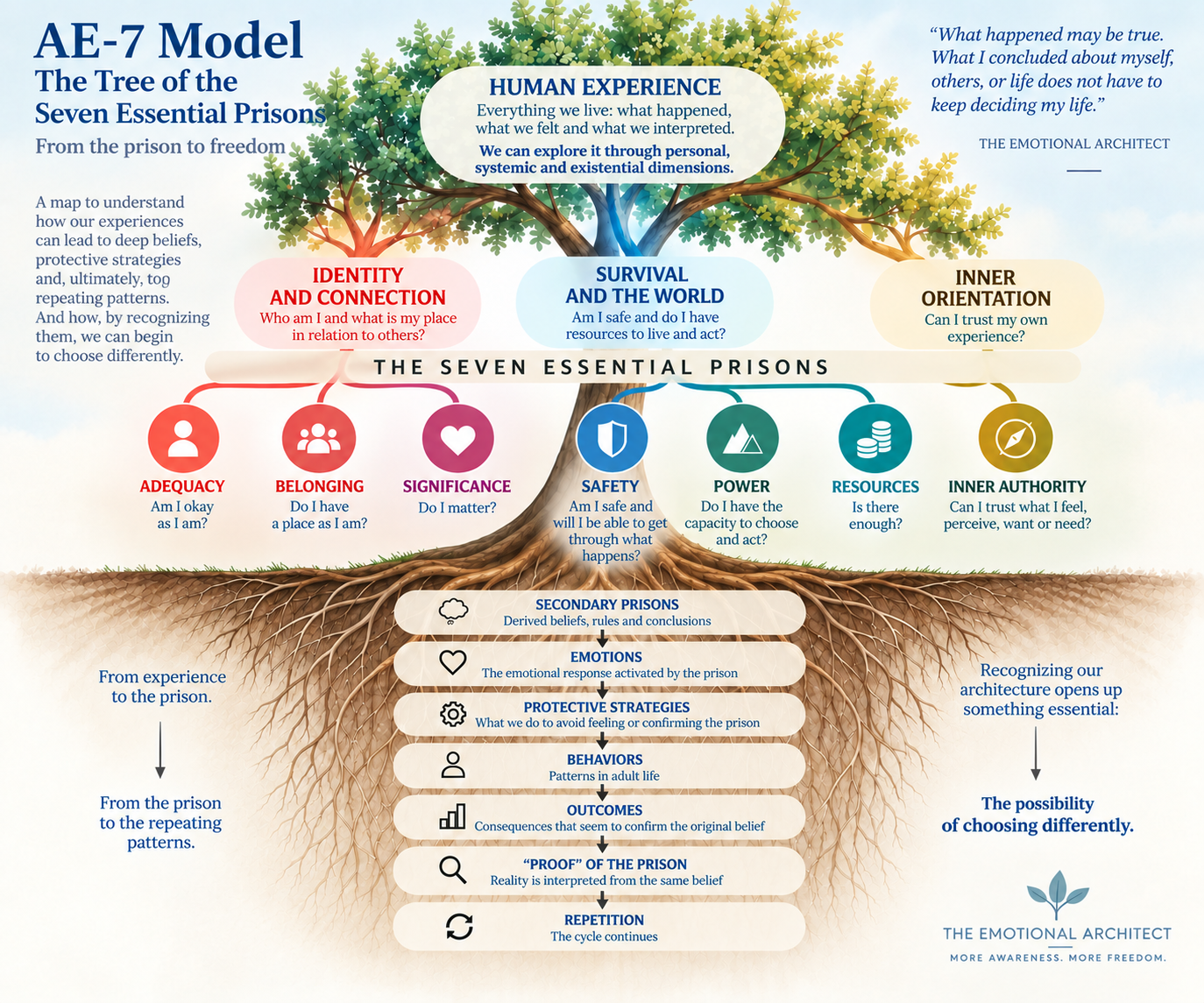
A Living Guide to the 7 Essential Prisons and Emotional Architecture
How to uncover the invisible architecture shaping your experience and reclaim your ability to choose
We do not react only to what happens.
We also react to the meaning we have learned to give to what happens.
An experience may have ended many years ago, and yet the conclusion we drew from it may still be shaping our lives:
“I am not enough.”
“They may leave me.”
“I don’t matter.”
“Something bad might happen.”
“There is nothing I can do.”
“There may not be enough.”
“I can’t trust myself.”
Over time, these conclusions may stop appearing as conscious thoughts and become ways of living.
We control.
We please others.
We push ourselves.
We avoid.
We anticipate.
We try to prove our worth.
We take care of everyone.
We find it difficult to ask for help.
We doubt our decisions.
We try to secure the future.
And we may eventually call personality what perhaps began as a way of adapting.
The AE-7 Model invites us to look beneath these strategies.
Not to classify ourselves.
Not to turn seven roots into seven new labels.
But to ask better questions.
WHAT IS AN EMOTIONAL PRISON?
An emotional prison is not simply a negative thought.
It is a conclusion formed from our experience that can begin to function as if it were a truth through which we interpret what we live.
We can represent it like this:
EXPERIENCE
↓
MEANING
↓
EMOTIONAL PRISON
↓
EMOTION
↓
PROTECTIVE STRATEGY
↓
BEHAVIOR
↓
RESULT
↓
CONFIRMATION
↓
REPETITION
The prison is not maintained simply because we think it.
It may persist because we learn to live from it.
THE 7 ESSENTIAL PRISONS
AE-7 proposes seven fundamental questions around which many of our emotional conclusions may become organized.
1 — ADEQUACY
Am I okay as I am?
It may appear around conclusions such as:
“I am not enough.”
“There is something wrong with me.”
“I should be different.”
2 — BELONGING
Do I have a place as I am?
It may appear around the fear of abandonment, rejection, or losing connection:
“They may leave me.”
“They don’t love me.”
“I don’t have a place.”
3 — SIGNIFICANCE
Do I matter?
Here we encounter the question of our significance in relationships and in the world:
“Nobody sees me.”
“I don’t matter.”
“My needs don’t count.”
4 — SAFETY
Am I safe, and will I be able to get through whatever happens?
It may appear as:
“Something bad might happen.”
“I’m not safe.”
“I have to be prepared.”
Safety does not necessarily mean believing that nothing difficult will ever happen.
The deeper question may be:
If something difficult happens, do I trust that I will be able to get through it?
5 — AGENCY
Do I have the ability to choose and act?
Here we may encounter:
“I can’t.”
“I have no choice.”
“I’m trapped.”
Even control can conceal a sense of powerlessness.
The question then becomes:
What options do I believe I have?
6 — RESOURCES
Is there enough?
This may become organized around money, time, work, energy, opportunities, attention, or support:
“There may not be enough.”
“I might run out.”
The deeper question is not simply how much we have, but:
What would it mean to me to run out?
7 — INNER AUTHORITY
Can I trust my own experience?
It may appear as:
“I don’t know what I want.”
“Maybe I’m wrong.”
“Other people know better than I do.”
“I can’t trust what I feel.”
The question is:
Can I listen to my own experience without needing someone else to validate it in order for it to be real?
FROM THE SURFACE TO THE ROOT
One of the keys to the AE-7 Model is not to confuse what we do with the deeper reason why we do it.
Perfectionism, control, people pleasing, procrastination, hyper-independence, or the need for recognition may be strategies.
But a strategy does not automatically tell us which prison lies beneath it.
Two people may do exactly the same thing for completely different reasons.
This is why AE-7 uses a form of inquiry we call:
EMOTIONAL REVERSE ENGINEERING
Instead of immediately trying to change the behavior, we begin to move deeper:
BEHAVIOR
↓
STRATEGY
↓
EMOTION
↓
FEAR
↓
MEANING
↓
PRISON
↓
ESSENTIAL ROOT
And we use a fundamental question:
WHAT WOULD HAVE TO BE TRUE FOR THIS STRATEGY TO MAKE SENSE?
If I need to control everything:
What would I have to believe for control to feel necessary?
If I need to please others:
What am I afraid would happen if I stopped?
If I can never rest:
What might it mean to me to stop striving?
If I constantly need to prove my worth:
What would I have to believe about myself to need to prove it?
We are not looking for automatic answers.
We investigate.
Because:
THE STRATEGY POINTS THE WAY.
IT DOES NOT DIAGNOSE.
WHAT HAPPENED AND WHAT I CONCLUDED
This is perhaps one of the most important distinctions in AE-7.
One thing is:
WHAT HAPPENED.
Another is:
WHAT I CONCLUDED FROM WHAT HAPPENED.
A relationship may have ended.
Someone may have rejected us.
We may have gone through financial difficulties.
We may have asked for help and not received it.
Those events belong to our history.
But conclusions such as:
“People always leave me.”
“There is something wrong with me.”
“There will never be enough.”
“I can only rely on myself.”
may continue to participate in our present long after the original experience has ended.
This is where AE-7 opens up a possibility:
WHAT HAPPENED MAY BE TRUE.
But:
WHAT I CONCLUDED ABOUT MYSELF, OTHER PEOPLE, OR LIFE DOES NOT HAVE TO KEEP DECIDING MY LIFE.
LEAVING THE PRISON
Understanding our emotional architecture is not the end.
It is the beginning of a different possibility.
The journey proposed by AE-7 is:
SEE
↓
DIFFERENTIATE
↓
QUESTION
↓
FEEL
↓
RECLAIM THE ABILITY TO CHOOSE
↓
ACT DIFFERENTLY
↓
CREATE A NEW EXPERIENCE
This is not about eliminating our emotions.
We can feel fear without automatically concluding that we are in danger.
We can feel lonely without concluding that nobody loves us.
We can feel shame without concluding that there is something fundamentally wrong with us.
We can feel uncertainty without concluding that we cannot trust our own experience.
Transformation can begin when we recognize:
“This is what I am feeling.”
Then:
“This is the conclusion my mind is turning into truth.”
And finally:
“I DO NOT HAVE TO KEEP ORGANIZING MY LIFE AROUND THAT CONCLUSION.”
The prison may have a history.
It may have served a purpose.
It may even have been an intelligent way of protecting ourselves or adapting at another point in our lives.
Understanding it does not mean fighting it.
It means reclaiming the possibility of asking:
WHAT CAN I CHOOSE NOW?
THE MAP POINTS THE WAY.
THE PERSON REVEALS THE MEANING.
AE-7 does not attempt to tell you who you are.
Nor does it turn your experience into a diagnosis.
It is a map designed to help you investigate what emotional architecture may be shaping what you are experiencing.
And when we can see it, differentiate it, and question it, a possibility may emerge that we could not see before:
living a different experience.
THIS IS THE MAP. THE JOURNEY CONTINUES.
This page brings together the essential ideas of the AE-7 Model.
It is a map for beginning to observe what may lie beneath our reactions, emotions, and strategies, and to discover the conclusions from which we may be organizing our experience.
But knowing the map is only the beginning.
AE-7 continues through the books, the cases, and an ever-growing library.
BOOK I
AE-7 · THE 7 ESSENTIAL PRISONS
How to uncover the invisible architecture shaping your experience and reclaim your ability to choose
The first book develops the complete map of the AE-7 Model.
We explore how an experience can acquire meaning, how that meaning can become an emotional prison, and how emotions, protective strategies, and ways of living can emerge from it and ultimately reinforce what we originally came to believe.
The book explores the 7 Essential Prisons:
1. ADEQUACY
Am I okay as I am?
2. BELONGING
Do I have a place as I am?
3. SIGNIFICANCE
Do I matter?
4. SAFETY
Am I safe, and will I be able to get through whatever happens?
5. AGENCY
Do I have the ability to choose and act?
6. RESOURCES
Is there enough?
7. INNER AUTHORITY
Can I trust my own experience?
We also learn to use one of the model’s fundamental tools:
EMOTIONAL REVERSE ENGINEERING
A process that allows us to begin with what we can see—the behavior or strategy—and investigate what fear, meaning, or conclusion may lie beneath it.
The book includes exploratory questions, exercises, and three complete cases that allow us to see the model in action.
→ DISCOVER BOOK I
BOOK II
AE-7 · 33 CASES OF EMOTIONAL ARCHITECTURE
The Laboratory of Emotional Prisons
If the first book presents the map, the second invites us into the laboratory.
Here, AE-7 moves beyond a conceptual framework and begins to reveal itself through real human experiences.
33 cases.
33 investigations.
33 ways of observing how what appears on the surface can lead us toward completely different emotional architectures.
Control.
Perfectionism.
Fear of abandonment.
Need for recognition.
People pleasing.
Over-responsibility.
Powerlessness.
Scarcity.
Difficulty making decisions.
The need to prove oneself.
Dependence.
Hyper-independence.
We do not begin with these behaviors in order to automatically assign a prison.
We use them as doorways into inquiry.
Because the same strategy may be trying to protect different people from entirely different things.
The laboratory helps us move from:
“What is wrong with me?”
to a different question:
“WHAT ARCHITECTURE MAY BE SHAPING WHAT I AM EXPERIENCING?”
Readers of Book II also receive online access to the 33 AE-7 cases and their updates.
→ ENTER THE LABORATORY
BOOK II · LIBRARY EDITION
THE AE-7 LIVING LIBRARY
A Progressive Collection of 105 Emotional Architecture Cases
For those who want to continue exploring, Book II · Library Edition opens another dimension of the project.
This is not simply about reading a book.
It is about gaining access to a living library.
The AE-7 Library begins with the 33 cases from Book II and continues to grow progressively with:
105 AE-7 CASES
The first 33 form the initial core of the Library. From there, new cases are progressively added until the collection reaches PC-105.
Each new case offers another opportunity to observe how the seven essential roots may participate in very different human experiences.
The Library can be explored not only by case number, but also by what a person is experiencing and by the different roots of the AE-7 Model.
Because the more experiences we are able to observe, the easier it may become to recognize our own architecture.
33 CASES TO BEGIN.
105 CASES TO KEEP EXPLORING.
The AE-7 Living Library does not aim to provide 105 answers.
It aims to open 105 spaces for inquiry.
→ ACCESS THE LIBRARY EDITION
THREE WAYS TO ENTER AE-7
THE MAP
Understand the 7 Essential Prisons and discover how our Emotional Architecture may become organized.
THE LABORATORY
Observe the model in action through 33 experiences and learn to recognize different emotional architectures.
THE LIVING LIBRARY
Continue exploring through a collection that will progressively grow to include 105 AE-7 cases.
THE MAP POINTS THE WAY.
THE PERSON REVEALS THE MEANING.
THE CASES HELP US RECOGNIZE.
AND A NEW EXPERIENCE CAN RESTORE OUR ABILITY TO CHOOSE.
FINAL NOTE
NOT EVERYTHING WE RECEIVE FROM THE PAST IS A PRISON
Exploring our emotional architecture can help us recognize fears, beliefs, adaptations, and strategies that may have been part of the way we live for a long time.
But looking into the past does not mean searching only for what we need to change.
From our history, we also receive resources, abilities, lessons, strengths, and ways of navigating life that may continue to be valuable to us.
Understanding our emotional architecture, therefore, is not about rejecting who we have been or freeing ourselves from everything we have received.
It is also about being able to distinguish:
WHAT DO I WANT TO KEEP?
WHAT DO I WANT TO DEVELOP?
AND WHAT DO I NO LONGER NEED TO KEEP REPEATING?
UNDERSTANDING WHAT WE HAVE RECEIVED EXPANDS OUR ABILITY TO CHOOSE WHAT WE WANT TO DO WITH IT.
The past is part of our story.
But it does not have to decide our future.