
AE-7 Map – 11 Audios – AE-7 Model – 33 Cases – 105 Cases – Book I
Book Summary:
THE 7 ESSENTIAL PRISONS OF THE AE-7 MODEL
Versión en español (castellano) >>>

The 7 Essential Prisons – Digital PDF >>>
(The printed book includes this Bonus Gift)
 The 7 Essential Prisons – Las 7 Prisiones Esenciales – 2 PDFs in English & Spanish >>>
Examples of comments about the AE-7 Book>>>
WHAT IF WHAT LIMITS YOU TODAY HAD A MEANING YOU HAVE NOT YET DISCOVERED?
Here are three cases with free access to see how the AE-7 model works:
PC-7 -En· “Everything Depends on Me”
PC-11-En · “I’m Not Enough”
PC-32-En · “To Be Safe, I Can’t Bother Anyone”
What would you say about a therapeutic exploration model that could help you look beyond the visible problem?
What if behind some of your fears, blocks, conflicts, or recurring patterns there were deep conclusions that you learned to regard as true?
What if some of the strategies that limit you today began, at another point in your life, as a way to protect yourself, adapt, or keep moving forward?
What if what you call insecurity, perfectionism, the need for control, dependency, self-reliance, difficulty setting boundaries, or the need to please others were only the visible part of something deeper?
And above all:
WHAT COULD CHANGE IF YOU DISCOVERED THE EMOTIONAL ARCHITECTURE BENEATH IT?
AE-7 Model · Emotional Architecture — Book I
How to discover the invisible architecture that organizes your experience and reclaim your capacity to choose.
Some experiences end, yet the conclusions we form from them can continue to organize our lives for years.
“I’m not enough.”
“They’re going to leave me.”
“I don’t matter.”
“Something bad might happen.”
“There’s nothing I can do.”
“There might not be enough.”
“I can’t trust myself.”
Often, these conclusions do not even appear as conscious thoughts. Instead, they show up as ways of living: pleasing others, controlling, proving ourselves, avoiding, anticipating, demanding more of ourselves, taking care of everyone, not asking for help, or constantly doubting our decisions.
The AE-7 Model proposes exploring what may lie beneath these strategies.
Not to classify us.
Not to diagnose us.
But to ask better questions.
Because two people can do exactly the same thing for completely different reasons.
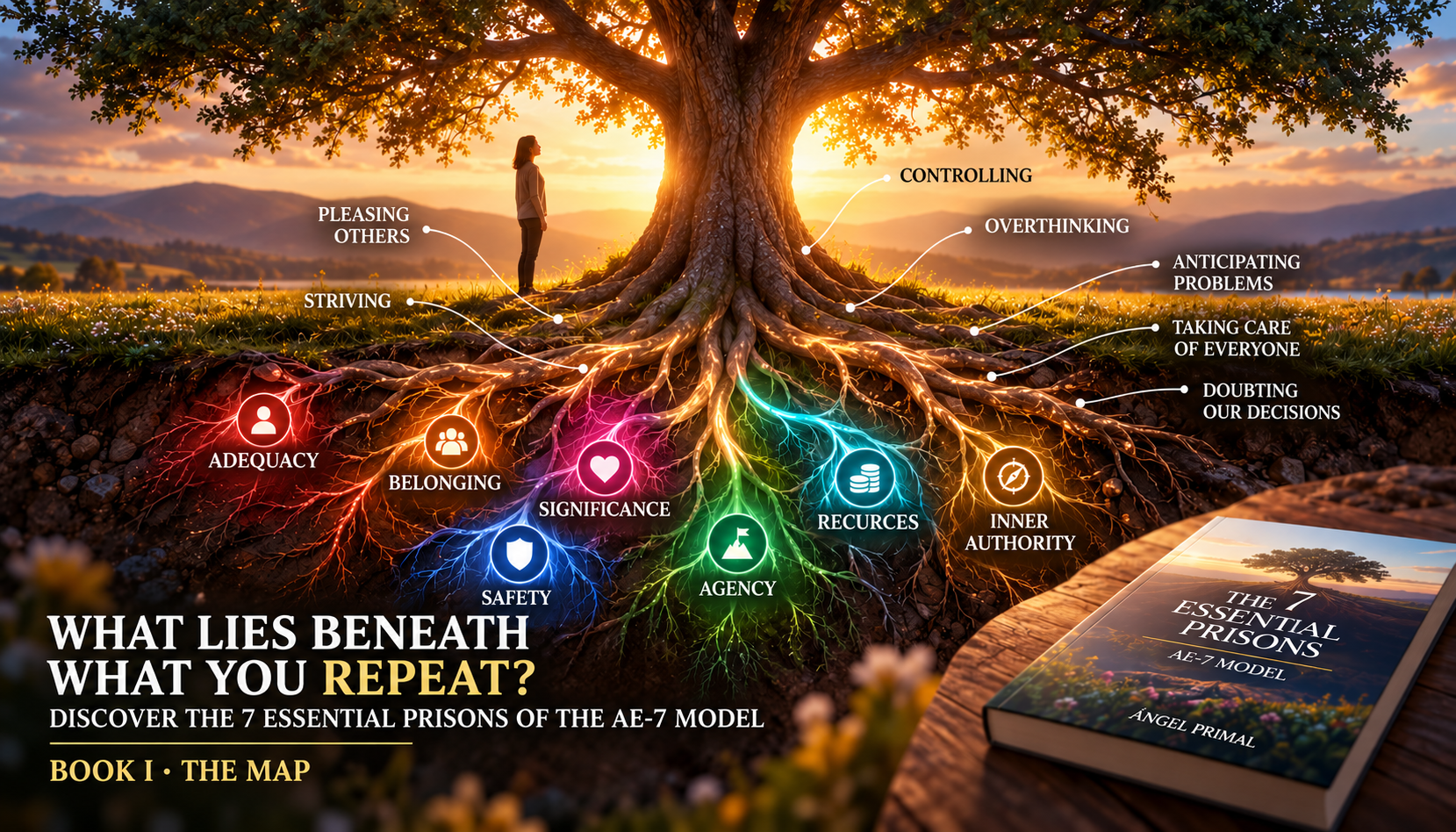
THE MAP GUIDES.
THE PERSON REVEALS THE MEANING.
AE-7 Book I: The 7 Essential Prisons
AE-7 organizes the exploration around seven fundamental questions:
1 · ADEQUACY
Am I okay as I am?
2 · BELONGING
Do I have a place as I am?
3 · SIGNIFICANCE
Do I matter?
4 · SAFETY
Am I safe, and will I be able to handle whatever happens?
5 · AGENCY
Do I have the capacity to choose and act?
6 · RESOURCES
Is there enough?
7 · INNER AUTHORITY
Can I trust my own experience?
These are not seven types of people or seven diagnoses. They are seven fundamental questions around which many human conclusions can become organized.
AE-7 Book I: From Behavior to the Root
One of the book’s central tools is Emotional Reverse Engineering.
Instead of immediately trying to change what we do, AE-7 proposes exploring what may lie beneath it:
BEHAVIOR
↓
STRATEGY
↓
EMOTION
↓
FEAR
↓
MEANING
↓
PRISON
↓
ESSENTIAL ROOT
The question that guides this journey is:
WHAT WOULD HAVE TO BE TRUE FOR THIS STRATEGY TO MAKE SENSE?
The same strategy can protect us from completely different things. That is why:
THE STRATEGY GUIDES. IT DOES NOT DIAGNOSE.
AE-7 Book I: From the Map to Experience
The book does more than introduce the seven roots.
It includes self-exploration questions, a practical worksheet for investigating specific situations, and three AE-7 cases published on the Emotional Architect website that allow you to observe how the model works:
PC-7 -En· “Everything Depends on Me”
PC-11-En · “I’m Not Enough”
PC-32-En · “To Be Safe, I Can’t Bother Anyone”
All three cases include free access to their complete online development.
Each case is expanded through two complementary perspectives: Family Constellations and Personal Constellations, without using them to impose a predetermined explanation about the origin of what we experience.
AE-7 Book I: From Repetition to Choice
Understanding our emotional architecture is not the end.
The book proposes seven movements:
SEE → DIFFERENTIATE → QUESTION → FEEL → RECLAIM THE CAPACITY TO CHOOSE → ACT DIFFERENTLY → CREATE A NEW EXPERIENCE
Because transformation is not only about thinking differently.
It is also about allowing ourselves to live differently.
THE MAP
The 7 Essential Prisons is Book I of Emotional Architecture.
A map for observing what repeats itself, exploring the meanings that may lie beneath it, and opening a fundamental question:
Do I have to keep organizing my life around that conclusion?
The past is part of our story.
But it does not have to decide our future.
ACCESS THE COMPLETE BOOK
The 7 Essential Prisons · AE-7 Model
How to discover the invisible architecture that organizes your experience and reclaim your capacity to choose.
Digital PDF book · Ángel Primal
GET THE BOOK · THE 7 ESSENTIAL PRISONS >>>
THE JOURNEY CONTINUES
The 7 Essential Prisons presents the map of the AE-7 Model.
But knowing the map is only the beginning.
The next step is to observe how the seven essential roots can appear, interact, and combine in real human experiences.
BOOK II · THE LABORATORY
33 CASES OF EMOTIONAL ARCHITECTURE
The Laboratory of Emotional Prisons
If Book I presents the map, Book II invites us into the laboratory.
33 experiences.
33 investigations.
33 opportunities to observe how the same visible behavior can lead toward different emotional architectures.
Cases PC-7-En, PC-11-En, and PC-32-En, introduced in Book I, are part of these 33 cases and remain available with free access.
Readers of Book II also receive an access code or password to explore the remaining 30 cases online, along with their updates.
3 freely accessible cases + 30 cases through Book II access = 33 cases.
EXPLORE THE 33 CASES · BOOK II
BOOK II · EXPANDED EDITION
105 CASES TO CONTINUE EXPLORING
The exploration can continue beyond the initial 33 cases.
The Expanded Edition extends the laboratory into a collection of 105 AE-7 cases, allowing us to observe a much wider variety of experiences, strategies, meanings, and combinations among the seven essential roots.
Each case becomes a new space for investigation.
The aim is not to find 105 predetermined answers, but to encounter more experiences from which we can learn to ask questions, differentiate, and recognize different emotional architectures.
33 CASES TO BEGIN.
105 CASES TO CONTINUE EXPLORING.
EXPLORE THE COLLECTION OF 105 CASES
THREE LEVELS OF EXPLORATION
BOOK I · THE MAP
Understand the 7 Essential Prisons and learn how to explore emotional architecture.
↓
BOOK II · THE LABORATORY
Observe the model in action through 33 cases of Emotional Architecture.
↓
BOOK II · EXPANDED EDITION
Continue the exploration through a library of 105 AE-7 cases.