
AE-7 Map – 11 Audios – AE-7 Model – 33 Cases – 105 Cases – Book I
PC-7-B-En — “It Is All Up to Me”
Exploration Through Personal Constellations
Exploration Through Personal Constellations in SPANISH >>>
PC-7-B-En — “It Is All Up to Me”
Exploration Through Personal Constellations
In PC-7-En, we explore an experience organized around:
“EVERYTHING DEPENDS ON ME.”
Through the AE-7 Model, we have investigated the emotional architecture that may be organizing this experience, and we have found reasons to explore especially:
SAFETY
alongside other territories that may also be involved, such as:
BELONGING · POWER
We have also observed strategies such as:
TAKING RESPONSIBILITY · CONTROLLING · UNDERSTANDING · SOLVING · SUPPORTING ONESELF · MOVING FORWARD
But now we are going to change perspective.
In PC-7-A-En, Family Constellations ask:
WHAT APPEARS WHEN THE PERSON OBSERVES HERSELF IN RELATION TO HER SYSTEM?
In PC-7-B-En, we turn our attention toward her own biography.
The question is:
WHICH AGES, VOICES, OR LIFE STAGES PARTICIPATE IN THE EXPERIENCE OF “EVERYTHING DEPENDS ON ME”?
We do not know the answer.
Therefore:
WE ARE NOT LOOKING FOR A PARTICULAR AGE.
WE ARE NOT LOOKING FOR A PARTICULAR WOUND.
WE ARE NOT LOOKING FOR A STORY THAT CONFIRMS OUR MAP.
We observe.
PERSONAL CONSTELLATIONS
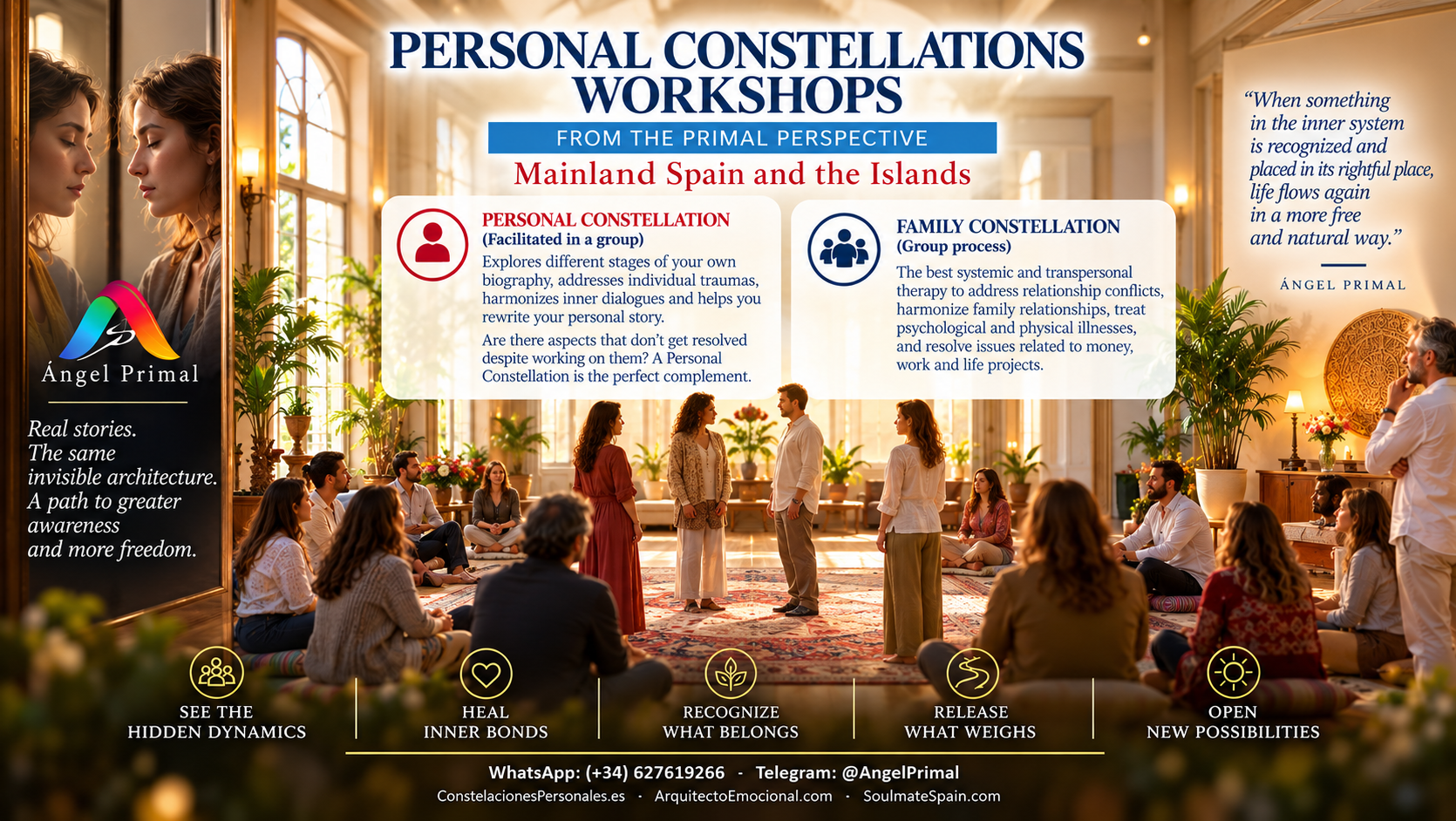
Personal Constellations use representatives to explore different moments in a person’s own biography.
We might begin with the basic selection of representatives:
BABY · GIRL · ADOLESCENT · YOUNG WOMAN · ADULT WOMAN
but we can also begin with only a few and expand later if the process justifies it.
We do not understand these stages as independent personalities.
Nor do we claim that there is necessarily any inner fragmentation.
We use them as:
PHENOMENOLOGICAL REPRESENTATIONS OF DIFFERENT MOMENTS IN ONE’S OWN HISTORY.
And we observe:
POSITION · ORIENTATION · GAZE · SENSATION · EMOTION · TENSION · MOVEMENT
Before looking for words:
FIRST, WE OBSERVE.
WE ARE NOT LOOKING FOR “THE GIRL WHO HAD TO TAKE RESPONSIBILITY”
This principle is especially important in PC-7-En.
We do not begin by stating:
“AS A CHILD, SHE HAD TO TAKE RESPONSIBILITY FOR EVERYTHING.”
We do not assume:
“SHE COULD NOT TRUST HER PARENTS.”
Nor:
“SHE HAD TO GROW UP TOO SOON.”
We do not even assume that:
“EVERYTHING DEPENDS ON ME”
originated in childhood.
That would turn a hypothesis into a story.
Nor do we assume that:
THE GIRL IS WATCHFUL
THE ADOLESCENT IS TIRED
THE YOUNG WOMAN IS SELF-RELIANT
or:
THE ADULT WOMAN HAS TO INTEGRATE THEM.
All of this could appear.
Or it might not.
Therefore, we work in the opposite direction:
WE PLACE
↓
WE OBSERVE
↓
WE LISTEN
↓
WE MAKE A MOVEMENT
↓
WE OBSERVE AGAIN.
We might begin, for example, with:
GIRL · ADOLESCENT · ADULT WOMAN
Not because we know that these three ages contain the problem.
They are simply three sufficiently differentiated moments from which to begin observing.
We could also begin with another configuration if the biography or previous work justifies it.
Once they are placed:
WE DO NOT ASK THEM TO REPRESENT OUR THEORY.
We observe.
Where is each one?
Where is each one looking?
What distance is there between them?
Does any want to move closer?
Does any want to move away?
Does tension appear?
Calm?
Does any seek contact?
Does any avoid the others?
Does an impulse to move appear?
Does nothing particularly significant happen?
All of this is information.
IT IS NOT YET AN EXPLANATION.
WE LISTEN TO THE BODY BEFORE THE STORY
We can ask each representative:
“What do you notice standing there?”
Not:
“WHAT ARE YOU AFRAID OF?”
because there may be no fear.
Not:
“WHO ARE YOU WATCHING?”
because there may be no vigilance.
Not:
“WHAT ARE YOU TAKING RESPONSIBILITY FOR?”
because she may not be taking responsibility for anything.
We simply ask:
WHAT DO YOU NOTICE?
There may be:
TENSION · CALM · HEAVINESS · LIGHTNESS · RESTLESSNESS · STRENGTH · TIREDNESS · CLOSENESS · DISTANCE · AN IMPULSE TO MOVE
or something completely different.
An emotion may also arise spontaneously.
Or some words.
Or simply a movement.
Or silence.
We do not need to lead the representative from sensation to emotion and then toward a verbal explanation.
WE ALLOW THE PHENOMENON TO EXPRESS ITSELF AS IT APPEARS.
WORDS MAY COME LATER
If a representative experiences tension and a need to remain attentive, words such as these might spontaneously appear:
“I HAVE TO STAY ALERT.”
If another experiences tiredness, perhaps:
“I DON’T WANT TO KEEP DOING THIS.”
If another experiences strength and autonomy, perhaps:
“I CAN DO IT ON MY OWN.”
But:
WE DO NOT INTRODUCE THESE PHRASES TO PRODUCE THE PHENOMENON.
First, we observe what appears.
Words may come later.
Or they may not be necessary.
NOT EVERYTHING THAT APPEARS NEEDS TO BECOME WORDS.
WE INTRODUCE “EVERYTHING DEPENDS ON ME”
Once we have observed the initial configuration, we can introduce the central representative of the case:
“EVERYTHING DEPENDS ON ME”
as an independent element.
And we observe.
What happens?
Does any age orient toward this representative?
Does any move away?
Does any change position?
Does tension appear?
Relief?
Strength?
Tiredness?
Nothing particularly significant?
We do not ask:
“WHO LEARNED THAT EVERYTHING DEPENDS ON HER?”
We observe:
WHAT HAPPENS BETWEEN THE DIFFERENT AGES WHEN THIS REPRESENTATIVE ENTERS THE FIELD?
This allows us to investigate without deciding in advance where it began.
WHO REACTS?
The introduction of:
“EVERYTHING DEPENDS ON ME”
may produce a particularly clear movement in one of the represented ages.
Perhaps one of them orients toward this representative.
Perhaps she moves closer.
Perhaps her tension increases.
Perhaps another moves away.
Perhaps one remains completely indifferent.
We do not need to ask why.
We observe what happens.
And if we need to gather information from a representative, we keep the intervention at the level of experience:
“What do you notice there?”
The representative may describe:
TENSION · HEAVINESS · RESTLESSNESS · STRENGTH · TIREDNESS · CALM · NEED TO MOVE CLOSER · IMPULSE TO MOVE AWAY
or any other experience.
An emotion may also appear.
Or spontaneous words.
Or a movement.
Or silence.
But we are not looking for:
THE ORIGIN
nor:
THE EXPLANATION.
An age may react intensely to an experience without that experience having originated at that stage.
Therefore, we distinguish between:
PARTICIPATING IN THE EXPERIENCE
and:
HAVING ORIGINATED IT.
This distinction is fundamental.
Personal Constellations can show us which life stages participate in an experience without, by themselves, proving where or when it began.
WE LET THE CONFIGURATION SPEAK
From here, we do not need to turn what appears into a series of questions.
We work with the configuration.
Suppose the GIRL orients strongly toward:
“EVERYTHING DEPENDS ON ME.”
We let her remain there.
We observe.
We can allow her to move closer if that is her impulse.
Or to move away.
We can temporarily move “EVERYTHING DEPENDS ON ME” and observe what happens.
We can remove it.
Wait.
And reintroduce it.
WE PLACE → WE OBSERVE → WE MOVE OR REMOVE IF APPROPRIATE → WE OBSERVE AGAIN.
What changes?
We do not need to ask the girl:
“WHY DO YOU NEED EVERYTHING TO DEPEND ON YOU?”
Nor:
“WHAT ARE YOU AFRAID WILL HAPPEN IF IT DOESN’T DEPEND ON YOU?”
Nor:
“WHAT DOES IT MEAN TO YOU NOT TO TAKE RESPONSIBILITY?”
Those questions belong to another level of investigation.
Here, we observe what happens when the configuration changes.
“EVERYTHING DEPENDS ON ME” AS THE THREAD OF THE EXPLORATION
Once introduced, this representative can accompany us throughout the rest of the Constellation.
If one age changes position:
WHAT HAPPENS TO “EVERYTHING DEPENDS ON ME”?
If two ages move closer:
WHAT HAPPENS TO “EVERYTHING DEPENDS ON ME”?
If we introduce CONTROL:
WHAT HAPPENS TO “EVERYTHING DEPENDS ON ME”?
If HELP appears:
WHAT HAPPENS TO “EVERYTHING DEPENDS ON ME”?
If we later introduce MY PART, RECEIVING, “I DON’T KNOW,” or LIFE:
WHAT HAPPENS TO “EVERYTHING DEPENDS ON ME”?
We do not need to ask this question out loud every time.
It is our methodological reference as facilitators.
We observe whether there is a change in:
ITS POSITION · ITS DISTANCE · ITS ORIENTATION · ITS RELATIONSHIP WITH EACH AGE
and what happens in the configuration as a whole.
WE MAKE A MOVEMENT
If one representative appears particularly connected to “EVERYTHING DEPENDS ON ME,” we can make a small movement.
Not to correct her.
Not to teach her that she should let go.
Simply to obtain new information.
If she is very close, we can slightly increase the distance.
If she is constantly oriented toward that representative, we can change her orientation.
If she remains focused on another age, we can temporarily separate the two positions.
We can also temporarily remove:
“EVERYTHING DEPENDS ON ME”
and observe.
What happens in the configuration?
Does any age spontaneously change position?
Does more tension appear?
Less?
Does any representative look again for the place occupied by “EVERYTHING DEPENDS ON ME”?
Does another seem calmer?
Does nothing happen?
Then we can reintroduce it.
And compare.
THE CHANGE IN THE CONFIGURATION GIVES US INFORMATION.
We do not need to obtain it through a verbal explanation.
WE DO NOT ASSUME SAFETY
From AE-7, we have reasons to explore especially:
SAFETY.
But we do not introduce SAFETY into the Constellation in order to confirm the map.
Nor do we ask:
“DO YOU TAKE RESPONSIBILITY IN ORDER TO FEEL SAFE?”
Nor:
“WHAT ARE YOU AFRAID WILL HAPPEN IF YOU DON’T TAKE RESPONSIBILITY?”
because both questions begin to direct the experience toward an explanation.
If, during the Constellation, an experience related to:
DANGER · PROTECTION · FEAR · NEED TO STAY ALERT
appears spontaneously, we can observe it.
And if the phenomenon gives us sufficient reason, we can later introduce a representative for:
SAFETY.
We place it.
And observe.
What changes in the configuration?
Which ages react?
What happens to “EVERYTHING DEPENDS ON ME”?
Does any relationship appear between the two representatives?
Does nothing particularly significant happen?
We do not need to decide in advance what the answer should be.
And if SAFETY does not produce a relevant phenomenon:
WE DO NOT NEED TO MAKE IT THE CENTER OF THE CONSTELLATION.
AE-7 may have found reasons to explore that territory.
The Personal Constellation may show something else.
WE INTRODUCE ONLY WHAT IS NECESSARY
As the work progresses, reasons may appear to introduce other representatives.
For example:
CONTROL
HELP
RECEIVING
“I DON’T KNOW”
MY PART
WHAT IS NOT MINE TO CARRY
CAPACITY TO RESPOND
LIFE
But:
WE DO NOT NEED TO REPRESENT ALL OF THEM.
Each element enters because something that has occurred in the configuration makes it relevant to observe.
Not because it appears on our map.
If CONTROL does not emerge as a relevant territory:
WE DO NOT PLACE CONTROL.
If no significant reaction appears around HELP:
WE DO NOT NEED TO PLACE HELP.
If RECEIVING does not emerge:
WE DO NOT NEED TO WORK WITH RECEIVING.
The map may suggest possibilities.
THE PHENOMENON GUIDES WHICH ONES WE EXPLORE.
IF CONTROL APPEARS
Suppose one of the ages shows an intense need to remain attentive to what is happening.
Or spontaneously expresses something like:
“I NEED TO KNOW WHAT IS GOING TO HAPPEN.”
or:
“I CAN’T STOP PAYING ATTENTION.”
Then it may make sense to introduce a representative for:
CONTROL.
We place it.
And observe.
Does any age orient toward it?
Does any move closer?
Does any move away?
Does the configuration change?
And what happens to:
“EVERYTHING DEPENDS ON ME”?
We can move CONTROL.
Move it farther away.
Bring it closer.
Temporarily remove it.
And observe again.
We do not need to ask:
“WHAT IS CONTROL FOR?”
The relationship between the representatives may show us something before we need to construct an explanation.
Nor do we assume that CONTROL is a problem.
It may represent a capacity that has been extraordinarily useful.
CONTROL AND CAPACITY TO RESPOND
If CONTROL takes on a significant place, we can later introduce:
CAPACITY TO RESPOND.
Not as the correct replacement for CONTROL.
Nor because:
CONTROL = BAD
and:
CAPACITY TO RESPOND = GOOD.
We place both.
And observe.
How does each age respond to CONTROL?
How does each respond to CAPACITY TO RESPOND?
What happens to “EVERYTHING DEPENDS ON ME” in relation to each one?
We can change distances.
Orientations.
Allow spontaneous movements.
Temporarily remove one of them.
And compare.
If a phrase emerges from the movement itself, we can test it.
For example:
“I CAN’T CONTROL EVERYTHING THAT HAPPENS.”
And observe.
Later, if it makes sense:
“I CAN RESPOND TO WHAT HAPPENS.”
And we observe again.
Not because the second phrase is a truth that has to be learned.
But because we want to see what happens when it enters the experience.
IF HELP APPEARS
A movement may also appear that makes it relevant to introduce:
HELP.
We do not conclude:
“SHE DOESN’T KNOW HOW TO ASK FOR HELP.”
We place the representative.
And observe.
Does any age orient toward HELP?
Does any want to move closer?
Does another step back?
Does discomfort appear?
Calm?
Tension?
Relief?
Nothing?
And what happens to:
“EVERYTHING DEPENDS ON ME”?
We can change the distance between HELP and the different ages.
We can allow one to move closer if that impulse arises.
We can observe whether another needs to remain farther away.
We do not need all of them to have the same relationship with HELP.
One age may receive it easily.
Another may remain distant.
Another may show no reaction.
EACH LIFE STAGE MAY RELATE DIFFERENTLY TO THE SAME ELEMENT.
HELP AND RECEIVING ARE NOT THE SAME THING
If the phenomenon justifies it, we can differentiate:
HELP
from:
RECEIVING.
Not because we know there is a problem with receiving.
But because the configuration may show us that they do not produce the same experience.
We place RECEIVING.
And observe.
Which ages react?
Who moves closer?
Who moves away?
What changes?
And what happens to “EVERYTHING DEPENDS ON ME”?
A person may accept practical help and experience these differently:
CARE · ATTENTION · REST · RECOGNITION · SUPPORT
But we do not assume this is the case.
If RECEIVING adds no new information:
WE DO NOT NEED TO KEEP IT IN THE CONFIGURATION.
“I DON’T KNOW”
Another possible representative in PC-7-En is:
“I DON’T KNOW.”
It may be especially interesting if, during the Constellation, an intense need appears to:
UNDERSTAND · ANTICIPATE · SOLVE · KNOW WHAT TO DO
We do not assume what it will produce.
We place:
“I DON’T KNOW”
and observe.
Which ages react?
Does any move closer?
Does any become tense?
Does any remain calm?
What happens to “EVERYTHING DEPENDS ON ME”?
We can allow the representatives to remain in front of:
“I DON’T KNOW”
for a few moments without asking them to solve anything.
We simply observe.
If a possibility for movement arises spontaneously, a representative might try:
“RIGHT NOW, I DON’T KNOW.”
And remain there.
Then we observe what happens.
We do not need to add an explanation.
“MY PART”
If, during the Constellation, a clear tendency to assume multiple responsibilities appears, it may be useful to introduce:
MY PART
and perhaps later:
WHAT IS NOT MINE TO CARRY.
We do not decide in advance where the boundary lies.
We place the representatives.
And observe.
How does each age respond?
What happens to “EVERYTHING DEPENDS ON ME”?
Does any age move closer to MY PART?
Does any remain oriented toward WHAT IS NOT MINE TO CARRY?
Does anything change when we alter the distances?
Can any representative remain in front of MY PART without immediately turning toward everything else?
If the phenomenon supports it, we can test:
“I CAN DO MY PART.”
And observe.
Later, if it makes sense:
“THE REST IS NOT MINE TO CARRY.”
And we observe again.
We are not trying to convince any age.
We observe the response.
RESPONSIBILITY IS NOT OVER-RESPONSIBILITY
This may become an important learning in PC-7-En.
We are not trying to eliminate:
RESPONSIBILITY
AUTONOMY
CAPABILITY
HELPING OTHERS
PROBLEM-SOLVING.
These are resources.
The work consists of observing when these capacities are available and when they seem to become an automatic necessity.
We can distinguish:
CAPACITY
from:
OBLIGATION.
“I CAN TAKE RESPONSIBILITY.”
is not necessarily the same as:
“I HAVE TO TAKE RESPONSIBILITY.”
But we do not need to teach this distinction to the representatives.
We can allow the configuration itself to show it.
THE ENCOUNTER BETWEEN DIFFERENT AGES
At some point, it may be useful to bring two representatives closer together.
For example:
ADULT WOMAN · GIRL
or:
ADULT WOMAN · ADOLESCENT
or any other combination that the process has made relevant.
We do not assume what one should say to the other.
First:
THEY LOOK AT EACH OTHER.
We observe.
What happens?
Is there recognition?
Distance?
Tension?
A desire to move closer?
Rejection?
Indifference?
We can briefly ask what each representative experiences:
“What do you notice there?”
And wait.
An emotion may appear.
A movement.
A word.
Silence.
Perhaps:
“I SEE YOU.”
Perhaps:
“I’M HERE NOW.”
Or perhaps something completely different.
THE DIALOGUE EMERGES FROM THE ENCOUNTER.
We do not write it beforehand.
THE ADULT WOMAN DOES NOT COME TO “SAVE” THE OTHERS
The adult representative may bring resources that are available in the present.
But we do not assume that she is:
WISER
STRONGER
THE ONE WHO HAS TO SOLVE EVERYTHING
or:
THE ONE WHO HAS TO INTEGRATE THE OTHERS.
That could reproduce precisely:
“EVERYTHING DEPENDS ON ME.”
We observe the adult woman too.
Perhaps she herself is deeply connected to that phrase.
Perhaps another age shows greater freedom.
Perhaps the adult woman orients toward an earlier stage.
Perhaps she receives something from it.
Perhaps something completely different happens.
WE DO NOT KNOW THE DIRECTION OF THE MOVEMENT.
We discover it.
WE DO NOT SEEK “INTEGRATION” AT ALL COSTS
The different ages do not need to end up:
IN A LINE
LOOKING IN THE SAME DIRECTION
AGREEING WITH ONE ANOTHER
or:
INTEGRATED INTO A PERFECT IMAGE.
It may be enough for something to have been seen.
For a distance to change.
For an emotion to become available that was not available before.
For one age to be able to look at another.
For “EVERYTHING DEPENDS ON ME” to occupy a different place.
For one age to move away from that representative.
Or move closer to another.
Or for none of this to happen and something we had not anticipated to appear instead.
The reference is simple:
WE OBSERVE AGAIN.
WE RETURN TO “EVERYTHING DEPENDS ON ME”
Before finishing, we can deliberately return to the central representative of the case.
At the beginning, we introduced:
“EVERYTHING DEPENDS ON ME”
and observed how the different ages responded.
Now we look at it again.
Where is it?
Does it maintain the same position?
Do the different ages still have the same relationship with it?
Can any of them look at it differently?
Has any moved closer?
Has any moved farther away?
Does any remain deeply connected to it?
Has another element appeared with which it now relates?
Does it remain exactly the same?
We do not need to make it disappear.
Because:
“EVERYTHING DEPENDS ON ME” MAY ALSO HAVE REPRESENTED A CAPACITY.
Perhaps it allowed her to solve problems.
Act.
Support herself.
Move forward.
Respond to difficult situations.
We do not need to tear that capacity out of her history.
We want to observe whether it continues to function solely as an obligation or whether it can now occupy a different place.
A NEW EXPERIENCE
If, during the Constellation, we discover that “EVERYTHING DEPENDS ON ME” has served an important function, we acknowledge it.
We do not try to replace it with:
“NOTHING DEPENDS ON ME ANYMORE.”
That would simply be the opposite extreme.
If the process genuinely leads there, movements such as these may appear:
“I CAN DO MY PART.”
“I CAN ASK FOR HELP.”
“I CAN RECEIVE.”
“RIGHT NOW, I DON’T KNOW.”
“I DON’T NEED TO CONTROL EVERYTHING THAT HAPPENS.”
“I CAN RESPOND TO WHAT HAPPENS.”
But we use only those formulations that arise from what has been observed.
We do not need a final phrase.
Nor a perfect configuration.
The transformation may simply consist of:
“EVERYTHING DEPENDS ON ME”
no longer occupying exactly the same place in the relationship between the different stages of her life.
THE MOVEMENT OF PC-7-B-En
WE BEGIN
with some relevant ages:
GIRL · ADOLESCENT · ADULT WOMAN
↓
WE OBSERVE
POSITION · ORIENTATION · GAZE · SENSATION · EMOTION · MOVEMENT · WORD · SILENCE
↓
WE LISTEN
without interpreting in advance
↓
WE INTRODUCE
representative of “EVERYTHING DEPENDS ON ME”
↓
WE OBSERVE
which ages react and how the configuration changes
↓
WE KEEP “EVERYTHING DEPENDS ON ME” AS THE THREAD OF THE EXPLORATION
↓
WE MAKE A MOVEMENT
we change a position · a distance · remove or introduce a representative · allow a spontaneous movement
↓
WE OBSERVE AGAIN
↓
WE INTRODUCE ONLY IF THE PHENOMENON JUSTIFIES IT
CONTROL · HELP · RECEIVING · “I DON’T KNOW” · MY PART · WHAT IS NOT MINE TO CARRY · CAPACITY TO RESPOND · LIFE
↓
WITH EACH NEW ELEMENT, WE OBSERVE
what changes in the different ages
and:
WHAT HAPPENS TO “EVERYTHING DEPENDS ON ME”?
↓
WE ALLOW ENCOUNTERS BETWEEN AGES
only when the configuration makes them relevant
↓
WE RETURN TO “EVERYTHING DEPENDS ON ME”
↓
WE OBSERVE WHAT HAS CHANGED
↓
THE PHENOMENON GUIDES THE NEXT STEP.
PC-7-B-En DOES NOT SEEK THE ORIGIN
This point deserves to be especially clear.
If the GIRL reacts intensely to:
“EVERYTHING DEPENDS ON ME”
we do not conclude:
“THAT IS WHERE IT ORIGINATED.”
If the ADOLESCENT reacts:
we do not conclude:
“THAT IS WHERE IT BECAME ESTABLISHED.”
If the YOUNG WOMAN reacts:
we do not conclude:
“THAT IS WHERE IT BECAME SELF-RELIANCE.”
Personal Constellations allow us to observe:
WHICH AGES, VOICES, OR LIFE STAGES PARTICIPATE IN THE CURRENT EXPERIENCE.
The historical origin requires additional information.
THREE PERSPECTIVES ON PC-7-En
PC-7-En — AE-7 MODEL
Question:
WHAT EMOTIONAL ARCHITECTURE IS ORGANIZING MY EXPERIENCE?
We begin with:
“EVERYTHING DEPENDS ON ME”
and apply Reverse Engineering.
Here we can investigate:
BEHAVIOR → STRATEGY → EMOTION → FEAR → MEANING → PRISON → ESSENTIAL ROOT
The map guides us toward different possible territories.
But:
THE MAP DOES NOT DECIDE THE MEANING.
PC-7-A-En — FAMILY CONSTELLATIONS
Question:
WHAT APPEARS WHEN I OBSERVE MYSELF IN RELATION TO MY SYSTEM?
We are not trying to prove that the family caused the prison.
We do not invent a story to explain over-responsibility.
WE PLACE · WE OBSERVE · WE MAKE A MOVEMENT · WE OBSERVE AGAIN · WE ADD ONLY WHAT IS NECESSARY.
PC-7-B-En — PERSONAL CONSTELLATIONS
Question:
WHAT APPEARS WHEN I OBSERVE MY DIFFERENT AGES AND THE RELATIONSHIP BETWEEN THEM?
And specifically in PC-7-En:
WHICH AGES, VOICES, OR LIFE STAGES PARTICIPATE IN THE EXPERIENCE OF “EVERYTHING DEPENDS ON ME”?
We do not assume that there is:
A WATCHFUL GIRL
A TIRED ADOLESCENT
A SELF-RELIANT YOUNG WOMAN
or:
AN ADULT WOMAN WHO HAS TO SOLVE EVERYTHING.
We observe.
What may appear is:
SENSATION · EMOTION · MOVEMENT · WORD · SILENCE
We do not establish in advance the order in which they should appear.
Nor do we need all of them to appear.
WE ALLOW THE PHENOMENON TO EXPRESS ITSELF AS IT APPEARS.
The aim is not to eliminate responsibility.
Nor autonomy.
Nor the ability to solve problems.
Nor the desire to help.
It is to recover:
THE CAPACITY TO CHOOSE.
So that:
“EVERYTHING DEPENDS ON ME”
can stop functioning as an automatic obligation without losing the capacities that may have developed around that experience.
Perhaps, if the process genuinely leads there:
“I CAN DO MY PART.”
Or:
“I CAN SUPPORT MYSELF WITHOUT HAVING TO CARRY EVERYTHING.”
But we do not need to decide in advance what the movement will be.
Because in Personal Constellations too: