
AE-7 Map – 11 Audios – AE-7 Model – 33 Cases – 105 Cases – Book I
PC-32-En — “To Be Safe, I Cannot Upset Others”
CASE SUMMARY
In PC-32-En, we explore a form of protection that can easily look like kindness, empathy, or consideration for others: “To Be Safe, I Cannot Upset Others.”
Hanane grew up in an unpredictable environment where, from a very young age, she learned to keep the peace: staying quiet, being careful, holding back what she felt, avoiding conflict, and paying close attention to the emotional state of those around her.
From the perspective of the AE-7 Model, people-pleasing is not necessarily the prison.
IT MAY BE THE STRATEGY.
If pleasing others, adapting, or staying quiet helps reduce conflict, we can continue asking:
WHAT DO I NEED TO PLEASE OTHERS FOR?
WHAT AM I AFRAID WILL HAPPEN IF SOMEONE GETS UPSET?
In this case, the exploration leads us primarily toward SAFETY and toward a possible internal rule:
“I HAVE TO KEEP THE PEACE IN ORDER TO BE SAFE.”
Another particularly important dimension also emerges, related to INTERNAL AUTHORITY: when our attention remains continuously focused on how others are doing, it can become increasingly difficult to hear:
WHAT DO I FEEL? · WHAT DO I WANT? · WHAT DO I NEED? · WHERE IS MY BOUNDARY?
This same case can be explored from three complementary perspectives:
PC-32-En — AE-7 MODEL
What emotional architecture is organizing my experience?
We explore how an initially protective strategy can become a cycle:
PLEASING OTHERS → AVOIDING UPSETTING OTHERS → AVOIDING CONFLICT → KEEPING THE PEACE → FEELING SAFE
and how that immediate relief may progressively reinforce the need to keep adapting.
PC-32-A-En — FAMILY CONSTELLATIONS
What appears when I observe myself in relation to my system?
We broaden the perspective toward the family system without assuming that the family is the cause of the need to please others or looking in advance for someone Hanane may have had to protect, calm, or keep happy.
We begin with a simple configuration, observe what appears, and introduce new elements only when the process itself gives us sufficient reason to do so.
→ PC-32-A-En — “To Be Safe, I Cannot Upset Others” through Family Constellations
PC-32-B-En — PERSONAL CONSTELLATIONS
What appears when I observe the different stages of my own life story?
We explore whether different ages, voices, or moments in her life still participate in the experience that my safety depends on other people being okay.
We do not assume that there is a child who is constantly watching, an adolescent who wants to express herself, or an adult woman disconnected from her own voice.
First, we observe the phenomenon. Then we listen to what sensation, emotion, or impulse emerges. And only then, if necessary, do we look for words that may express it.
→ PC-32-B-En — “To Be Safe, I Cannot Upset Others” through Personal Constellations
The three perspectives do not need to lead to the same explanation.
AE-7 observes the emotional architecture. Family Constellations broaden the perspective toward the system. Personal Constellations broaden the perspective toward the different stages of our own life story.
And all three can meet around one particularly important question:
CAN I STILL FEEL SAFE WHEN SOMEONE ELSE IS NOT HAPPY WITH ME?
The movement is not about going from taking others into consideration to ignoring them.
It is about including myself too:
“I CAN TAKE YOU INTO CONSIDERATION WITHOUT STOPPING TAKING MYSELF INTO CONSIDERATION.”
“I CAN SEE YOU WITHOUT LOSING SIGHT OF MYSELF.”
“I CAN BE MYSELF AND STILL BE SAFE.”

ORIGINAL VIDEO & AUDIO – PETER CRONE
This case corresponds to episode 18 of Finding Freedom with Peter Crone:
“Finding Freedom from People Pleasing with Hanane”
published on June 3, 2026, with an approximate duration of 1 hour and 14 minutes.
CASE ANALYSIS
PETER CRONE AND AE-7: TWO LEVELS OF READING THE SAME EXPERIENCE
PC-32-En — “To Be Safe, I Cannot Upset Others”
When Keeping the Peace Becomes a Form of Protection and We End Up Giving Up Our Own Expression to Avoid Upsetting Others
Peter Crone and the AE-7 Model — Case Analysis
Peter Crone and the AE-7 Model — Case Analysis in SPANISH >>>
Hanane grew up in:
AN UNPREDICTABLE ENVIRONMENT.
From a very young age, she felt that she had to:
KEEP THE PEACE.
And she learned to:
STAY QUIET
BE CAREFUL
HOLD BACK WHAT SHE FELT EMOTIONALLY
in order to:
AVOID CONFLICT
and:
PROTECT THOSE AROUND HER.
Over time, this way of functioning began to affect:
HER RELATIONSHIP WITH HERSELF
HER RELATIONSHIPS
and:
HER CAPACITY TO FULLY EXPRESS WHO SHE IS.
Peter takes the conversation toward the cost of moving through the world as an adult woman:
WITHOUT BEING FREE TO BE HERSELF.
The conversation explores the pressure of not upsetting others, the identities we may adopt in order to feel safe, and the possibility of questioning roles we have maintained for years.
Up to this point, we have elements that come directly from the case.
From here, our:
AE-7 REVERSE ENGINEERING
begins.
PEOPLE PLEASING IS NOT NECESSARILY THE PRISON
The episode title refers to:
PEOPLE PLEASING.
But pleasing others fundamentally describes a way of behaving.
For AE-7, this immediately opens a question:
WHAT FUNCTION DOES IT SERVE?
In Hanane, we find several elements that allow us to begin investigating:
AVOIDING CONFLICT
PROTECTING OTHERS
KEEPING THE PEACE
Therefore:
PEOPLE PLEASING
↓
STRATEGY
↓
WHAT FOR?
This question changes the investigation.
If we formulate:
“I HAVE TO PLEASE OTHERS.”
we still do not know what may lie underneath.
We need to continue:
WHAT DO I NEED TO PLEASE OTHERS FOR?
And then:
WHAT DOES IT MEAN TO ME WHEN THE OTHER PERSON GETS UPSET?
This is where Reverse Engineering really begins.
A STRATEGY THAT MADE SENSE
From a child’s perspective, trying to keep the peace in an environment experienced as unpredictable may make a great deal of sense.
We can explore whether rules such as these began to appear:
“BE CAREFUL.”
“DON’T UPSET ANYONE.”
“DON’T EXPRESS SOMETHING THAT MIGHT UPSET SOMEONE.”
“TRY TO MAKE SURE EVERYTHING IS OKAY.”
We do not know whether Hanane formulated these conclusions in exactly these words.
We do not need to attribute words to her that she did not say.
They serve as questions for investigation, helping us move closer to the meaning that conflict, emotional expression, and other people’s reactions may have acquired for her.
A child does not necessarily think:
“I’M GOING TO BECOME A PEOPLE PLEASER.”
She is trying to solve something.
The question is:
WHAT?
THE RADAR TOWARD OTHERS
If, before expressing myself, I constantly need to check:
HOW THE OTHER PERSON IS FEELING
WHAT THE OTHER PERSON NEEDS
WHAT MIGHT UPSET THEM
HOW THEY MIGHT REACT
my attention may gradually shift.
From:
“WHAT DO I FEEL?”
toward:
“HOW ARE THEY FEELING?”
From:
“WHAT DO I WANT?”
toward:
“WHAT CAN I DO TO MAKE SURE EVERYTHING IS OKAY?”
Sensitivity toward others can be an extraordinary capacity:
PERCEIVING · LISTENING · NOTICING TENSION · BEING CONSIDERATE · HAVING EMPATHY
The problem is not the capacity itself.
The question is:
WHEN DOES A CAPACITY BECOME AN OBLIGATION?
We can move from:
“I CAN NOTICE HOW YOU ARE FEELING.”
to:
“I HAVE TO KNOW HOW YOU ARE FEELING.”
And from:
“I CAN TAKE YOUR EMOTIONS INTO ACCOUNT.”
to:
“I HAVE TO PREVENT YOU FROM GETTING UPSET.”
Then sensitivity may become:
VIGILANCE.
The difference is not necessarily in what we do.
It may be in:
THE INNER PLACE FROM WHICH WE NEED TO DO IT.
WHAT DOES IT MEAN WHEN SOMEONE GETS UPSET?
We now reach a fundamental question.
Hanane tries to keep the peace.
But:
WHAT IS AT STAKE WHEN THE PEACE DISAPPEARS?
The same behavior may be trying to resolve completely different internal experiences.
If what appears is:
“If someone gets upset, something bad may happen.”
we can explore:
SAFETY
If what appears is:
“If someone gets upset with me, I may lose the connection.”
we can explore:
BELONGING
If what appears is:
“If someone gets upset with me, it means I have done something wrong.”
we can explore:
ADEQUACY
If what appears is:
“What I need matters less than what others need.”
we can explore:
SIGNIFICANCE
If what appears is:
“If the other person is upset by what I feel, perhaps I cannot trust my own experience.”
we can explore:
INNER AUTHORITY
The external behavior may be exactly the same:
PLEASING OTHERS.
But the architecture organizing it may be different.
Therefore:
A STRATEGY DOES NOT AUTOMATICALLY TELL US WHAT THE ROOT IS.
THE MAP GUIDES. THE PERSON REVEALS THE MEANING.
SAFETY: A HYPOTHESIS WORTH EXPLORING
In Hanane’s material, there is one particularly significant element:
AN UNPREDICTABLE ENVIRONMENT
together with:
AVOIDING CONFLICT · PROTECTING · KEEPING THE PEACE
This gives us reason to explore one of the AE-7 territories:
SAFETY
AM I SAFE, AND WILL I BE ABLE TO HANDLE WHAT HAPPENS?
We do not need to conclude that Safety is necessarily the root.
But we can ask:
What happened for Hanane when conflict appeared?
What did she anticipate?
What did she need to avoid?
What could happen if another person became upset?
What did she feel in those moments?
If keeping the peace was not merely a preference but something she felt she had to do, we can investigate what experience made that strategy necessary.
A POSSIBLE PRISON
From the available elements, we can formulate a hypothesis:
“TO BE SAFE, I CAN’T UPSET OTHERS.”
We are not claiming that Hanane literally used these words.
Nor are we claiming that we have already found the definitive root of the case.
We use it as a provisional formulation that allows us to investigate a possible architecture:
UNPREDICTABLE ENVIRONMENT
↓
POSSIBILITY OF CONFLICT
↓
ACTIVATION
↓
“I HAVE TO KEEP THE PEACE.”
↓
STAYING QUIET · ADAPTING · HOLDING BACK · PLEASING OTHERS
↓
REDUCTION OF CONFLICT
↓
RELIEF
↓
“ADAPTING SEEMS TO PROTECT ME.”
If this sequence approximates Hanane’s experience, the strategy would not be absurd or a defect that needs to be eliminated.
It would have served a function.
WHEN CONFLICT IS EXPERIENCED AS DANGER
If, at certain moments in our biography:
CONFLICT → THREAT
our organism may later continue responding as though the two were equivalent.
But we need to introduce an important distinction:
CONFLICT DOES NOT AUTOMATICALLY MEAN DANGER.
Disagreement can exist without violence.
Anger can exist without destroying the relationship.
Disappointment can exist without meaning that we have done something wrong.
And, at the same time:
NOT ALL CONFLICT IS SAFE.
Therefore, the movement is not about learning:
“CONFLICT IS NEVER DANGEROUS.”
That would simply replace one generalization with another.
The movement is about recovering the capacity to:
DIFFERENTIATE.
WHAT IS HAPPENING HERE AND NOW?
IS THERE ACTUALLY DANGER?
OR IS MY ORGANISM RESPONDING TO A POSSIBILITY AS THOUGH IT WERE A CERTAINTY?
DISAGREEMENT, DISAPPOINTMENT, AND REJECTION
We can also investigate some possible equivalences.
“I DON’T AGREE WITH YOU”
does not necessarily mean:
“I DON’T LOVE YOU.”
“I’M UPSET”
does not necessarily mean:
“YOU ARE IN DANGER.”
And:
“YOU HAVE DISAPPOINTED ME”
does not necessarily mean:
“THERE IS SOMETHING WRONG WITH YOU.”
Likewise:
DISAPPOINTING SOMEONE DOES NOT NECESSARILY MEAN HARMING THEM.
Someone may be disappointed because I say:
NO.
That alone does not prove that my decision is wrong.
It may simply mean:
THE OTHER PERSON WANTED SOMETHING DIFFERENT.
THE IMPOSSIBLE RESPONSIBILITY
Within this architecture, another rule may also appear:
“IT IS MY RESPONSIBILITY TO MAKE SURE EVERYTHING IS OKAY.”
If it does, an important distinction becomes necessary.
I can be responsible for:
MY WORDS
MY DECISIONS
MY BEHAVIOR
HOW I EXPRESS A BOUNDARY
REPAIRING WHEN I CAUSE HARM
But I cannot completely control:
OTHER PEOPLE’S EMOTIONS
THEIR EXPECTATIONS
THEIR INTERPRETATIONS
THEIR DISAPPOINTMENT
THEIR ANGER
This allows us to distinguish:
RESPONSIBILITY
from:
CONTROL OVER THE OTHER PERSON’S EXPERIENCE.
INNER AUTHORITY: ANOTHER TERRITORY TO EXPLORE
When attention remains constantly oriented outward, there may be less space available to listen to:
WHAT DO I FEEL?
WHAT DO I WANT?
WHAT DO I NEED?
WHAT DON’T I WANT?
WHAT IS MY BOUNDARY?
This opens another territory for investigation:
INNER AUTHORITY
CAN I TRUST MY OWN EXPERIENCE?
Not because paying attention to others automatically demonstrates a difficulty with Inner Authority.
The question appears when:
WHAT I FEEL
comes into conflict with:
WHAT THE OTHER PERSON WANTS.
Then we can investigate:
CAN I CONTINUE TRUSTING WHAT I FEEL WHEN THE OTHER PERSON DOESN’T LIKE IT?
THE BOUNDARY AS INFORMATION
For someone organized around keeping the peace, saying:
NO
may activate:
FEAR · GUILT · ANTICIPATION · NEED TO EXPLAIN · NEED TO COMPENSATE
A boundary may be experienced as though it means:
REJECTION
CONFLICT
LACK OF LOVE
or even:
DANGER.
But a boundary can also simply be:
INFORMATION ABOUT ME.
“THIS IS WHAT I WANT.”
“THIS IS WHAT I DON’T WANT.”
“THIS IS WHAT I CAN DO.”
“THIS IS WHAT I CAN’T DO.”
The AE-7 question returns:
WHAT DOES SETTING A BOUNDARY MEAN TO ME?
We do not assume the answer.
We investigate it.
THE PRICE OF KEEPING THE PEACE
The strategy may work.
Hanane detects tension.
She adapts.
The tension decreases.
Relief appears.
The organism may learn:
“ADAPTING WORKS.”
That is precisely why a strategy can remain in place for years.
But we also need to observe its cost.
The case description indicates that this way of living begins to affect her relationship with herself, her relationships, and her capacity to fully express who she is.
We can represent it like this:
EXTERNAL PEACE
↓
STAYING QUIET · ADAPTING · HOLDING BACK
↓
LESS EXPRESSION OF MY NEEDS AND BOUNDARIES
↓
GREATER ATTENTION TO OTHER PEOPLE’S REACTIONS
↓
LESS CONTACT WITH WHAT I WANT
↓
GREATER NEED TO ADAPT
The strategy that attempts to solve a difficulty may begin to contribute to maintaining the same circuit.
THE PRISON BECOMES SELF-CONFIRMING
An especially important mechanism appears here.
If I fear:
“IF I EXPRESS WHAT I REALLY WANT, I MAY UPSET SOMEONE.”
and, in order to avoid that:
I DO NOT EXPRESS IT
I have fewer opportunities to discover what actually happens when I do express it.
The prediction remains largely untested.
Not because we know in advance that expressing myself will go well.
But because:
AVOIDING THE EXPERIENCE ALSO PREVENTS US FROM OBTAINING NEW INFORMATION.
I can spend years avoiding what I fear and, precisely because I avoid it, have few experiences that allow me to distinguish:
WHAT I FEAR WILL HAPPEN
from:
WHAT ACTUALLY HAPPENS.
WHEN A STRATEGY LOOKS LIKE OUR PERSONALITY
A strategy repeated for years may begin to feel like:
“THAT’S JUST WHO I AM.”
“I’M EASYGOING.”
“I DON’T LIKE CONFLICT.”
“I LIKE HELPING.”
“I DON’T NEED MUCH.”
Some of these characteristics may be completely genuine.
We do not need to turn the entire personality into an adaptation.
The question is different:
WHERE DOES IT COME FROM?
STAYING QUIET TO FEEL SAFE
does not necessarily mean:
I AM A QUIET PERSON.
ADAPTING TO AVOID CONFLICT
does not necessarily mean:
I AM NATURALLY FLEXIBLE.
NOT ASKING FOR THINGS SO I DON’T UPSET OTHERS
does not mean:
I HAVE NO NEEDS.
A capacity can be genuine and, at the same time, have been used as a protective strategy.
“I AM NOT FREE TO BE MYSELF”
Here one of the central elements of the case appears.
The strategy that sought to protect may end up limiting adult expression.
The question is no longer only:
“HOW DO I STOP PLEASING OTHERS?”
It can become:
“WHO AM I WHEN I NO LONGER NEED TO CONSTANTLY ORGANIZE MYSELF AROUND OTHER PEOPLE’S REACTIONS?”
If I continually ask:
“WHAT DO YOU WANT?”
I may lose contact with:
“WHAT DO I WANT?”
If I continually ask:
“ARE YOU OKAY?”
I may leave little space for:
“AM I OKAY?”
If I continually ask:
“DOES THIS UPSET YOU?”
I may forget to ask:
“DOES THIS UPSET ME?”
We do not need to move from always looking at the other person to no longer looking at them at all.
We need to:
INCLUDE MYSELF TOO.
QUESTIONING THE PRISON
If the formulation:
“TO BE SAFE, I CAN’T UPSET OTHERS.”
approximates Hanane’s experience, we can begin investigating it.
Not to immediately replace it with:
“I CAN UPSET EVERYONE AND NOTHING WILL HAPPEN.”
But to ask:
Is it true in every situation?
What exactly does “upset” mean?
Does someone becoming angry necessarily mean that I am in danger?
Does someone being disappointed mean that I have done something wrong?
Can I express a need and allow the other person to have their own reaction?
Can I distinguish between causing harm and not meeting someone’s expectation?
Which part of the responsibility belongs to me, and which belongs to the other person?
Questioning does not mean denying what happened.
It means investigating whether a conclusion that may have made sense under certain circumstances needs to continue organizing every situation in the present.
BEFORE THE STRATEGY
So far, we have mainly observed what Hanane learned to do:
STAY QUIET
HOLD BACK
OBSERVE
ADAPT
KEEP THE PEACE
PROTECT
But we can open another question:
WHAT HAPPENED BEFORE SHE NEEDED TO DO ALL OF THAT?
Here we enter a different territory.
We are not trying to construct an explanation that the material does not contain.
We do not know exactly what specific experiences gave rise to each adaptation.
Nor do we know what emotion would appear if Hanane explored those moments.
Therefore, we do not need to decide in advance whether we would find:
FEAR
SADNESS
POWERLESSNESS
LONELINESS
ANGER
or any other experience.
We can simply investigate:
WHAT HAPPENED WHEN THE ENVIRONMENT BECAME UNPREDICTABLE?
HOW DID THAT CHILD EXPERIENCE IT?
WHAT DID SHE FEEL IN HER BODY?
WHAT DID SHE NEED?
WHAT COULD SHE NOT EXPRESS?
WHAT DID SHE HAVE TO LEARN TO DO IN ORDER TO GET THROUGH THAT SITUATION?
Perhaps the journey was something like:
EXPERIENCE
↓
EMOTION
↓
NEED
↓
SURVIVAL STRATEGY
↓
ADAPTATION
↓
GENERALIZATION
But we do not need to impose that sequence.
The person and her experience will determine what appears.
WHAT I NEEDED TO DO THEN
This distinction may be fundamental.
We are not trying to tell the child:
“YOU SHOULDN’T HAVE ADAPTED.”
Perhaps adapting was intelligent.
Perhaps observing was useful.
Perhaps staying quiet protected something important.
Perhaps trying to keep the peace was the best possibility she could find at that time.
Therefore, we do not need to fight the strategy.
We can acknowledge it:
“THIS SERVED A FUNCTION.”
And then introduce a new question:
IS WHAT I NEEDED TO DO THEN THE SAME AS WHAT I NEED TO DO NOW?
There we begin to differentiate:
PAST
from:
PRESENT.
THE NEW EXPERIENCE
Transformation does not need to consist only of intellectually understanding:
“I DON’T HAVE TO PLEASE OTHERS ANYMORE.”
We need to recover the capacity to choose and allow different experiences.
For example:
I EXPRESS A PREFERENCE
↓
someone disagrees
↓
I OBSERVE WHAT HAPPENS.
Or:
I SAY NO
↓
someone is disappointed
↓
I OBSERVE WHAT HAPPENS IN ME, IN THE OTHER PERSON, AND IN THE RELATIONSHIP.
Or:
I EXPRESS A NEED
↓
the other person reacts
↓
I DIFFERENTIATE THEIR REACTION FROM MY RIGHT TO EXPRESS MYSELF.
The new experience does not consist of guaranteeing that no one gets angry.
It consists of discovering:
WHAT HAPPENS WHEN I STOP AUTOMATICALLY ORGANIZING MY BEHAVIOR AROUND AVOIDING EVERY POSSIBLE REACTION FROM OTHERS?
“I CAN UPSET OTHERS”
Perhaps one of the most challenging formulations for this architecture is:
“I CAN UPSET OTHERS.”
It does not mean:
“I WANT TO UPSET OTHERS.”
Nor does it mean:
“I DON’T CARE HOW OTHER PEOPLE FEEL.”
It means:
“I DO NOT NEED TO ORGANIZE MY ENTIRE LIFE AROUND GUARANTEEING THAT NO ONE GETS UPSET.”
I can be respectful.
I can listen.
I can communicate.
I can repair when I make a mistake.
And at the same time recognize:
I CANNOT COMPLETELY CONTROL HOW EVERY PERSON WILL REACT.
FROM ADAPTATION TO CHOICE
We do not need to reject the strategy.
We can acknowledge:
“THIS SERVED A FUNCTION.”
Staying quiet may have served a function.
Observing may have served a function.
Adapting may have served a function.
Keeping the peace may have served a function.
And then investigate:
“DO I NEED TO USE THIS STRATEGY AUTOMATICALLY NOW?”
Here the possibility of recovering choice appears.
Hanane can continue being:
EMPATHETIC
CONSIDERATE
CAREFUL
ATTENTIVE
without those qualities always needing to be organized around fear of other people’s reactions.
Before:
“I HAVE TO BE CONSIDERATE IN ORDER TO BE SAFE.”
After:
“I CAN BE CONSIDERATE BECAUSE I WANT TO.”
The external behavior may look identical.
THE INTERNAL ARCHITECTURE MAY BE COMPLETELY DIFFERENT.
THE SPECIAL CONTRIBUTION OF PC-32-En TO THE AE-7 MODEL
PC-32-En allows us to observe a particularly important distinction:
A STRATEGY DOES NOT TELL US WHAT THE PRISON IS.
Two people can do exactly the same thing:
PLEASE OTHERS.
But they may do it from different architectures.
One may please others because:
“IF THERE IS CONFLICT, I MAY BE IN DANGER.”
→ SAFETY
Another:
“IF THEY DON’T LIKE ME, I MAY LOSE MY PLACE.”
→ BELONGING
Another:
“IF THEY GET UPSET WITH ME, IT MEANS I HAVE DONE SOMETHING WRONG.”
→ ADEQUACY
Another:
“WHAT THE OTHER PERSON NEEDS MATTERS MORE THAN WHAT I NEED.”
→ SIGNIFICANCE
Another:
“IF THE OTHER PERSON THINKS I AM WRONG, I NO LONGER KNOW WHETHER I CAN TRUST WHAT I FEEL.”
→ INNER AUTHORITY
That is why AE-7 does not classify based on behavior.
It asks:
WHAT DO I DO THIS FOR?
And then:
WHAT WOULD HAVE TO BE TRUE FOR THIS STRATEGY TO MAKE SENSE?
That is where Emotional Reverse Engineering begins.
SUMMARY OF THE ARCHITECTURE
After exploring the case, we can bring together the main hypotheses that have appeared.
They do not constitute a diagnosis of Hanane.
They are a map for continuing to investigate her experience.
EXPERIENCE
UNPREDICTABLE ENVIRONMENT · CONFLICT · NEED TO KEEP THE PEACE
↓
MEANING TO INVESTIGATE
“WHEN SOMEONE BECOMES UPSET, SOMETHING IMPORTANT MAY BE AT RISK.”
↓
MAIN ROOT TO EXPLORE
SAFETY
“AM I SAFE, AND WILL I BE ABLE TO HANDLE WHAT HAPPENS?”
↓
POSSIBLE PRISON
“TO BE SAFE, I CAN’T UPSET OTHERS.”
↓
RULES
“I HAVE TO KEEP THE PEACE.”
“I HAVE TO BE CAREFUL.”
“I MUST NOT CREATE CONFLICT.”
↓
STRATEGIES
PLEASING OTHERS · STAYING QUIET · ADAPTING · HOLDING BACK · ANTICIPATING · APPEASING
↓
IMMEDIATE RESULT
LESS TENSION · LESS CONFLICT · RELIEF
↓
LEARNING
“ADAPTING SEEMS TO PROTECT ME.”
↓
COST
LESS EXPRESSION · LESS CONTACT WITH NEEDS AND BOUNDARIES · GREATER ATTENTION TO OTHER PEOPLE’S REACTIONS
↓
SELF-CONFIRMATION
AVOIDING EXPRESSING MYSELF REDUCES MY OPPORTUNITIES TO DISCOVER WHAT HAPPENS WHEN I DO EXPRESS MYSELF
↓
ASSOCIATED TERRITORIES TO EXPLORE
INNER AUTHORITY · BELONGING · ADEQUACY · SIGNIFICANCE
↓
POSSIBLE MOVEMENT
FROM REACTION TO CHOICE
“I CAN LISTEN TO YOUR REACTION WITHOUT AUTOMATICALLY ABANDONING MY OWN EXPERIENCE.”
THE MOVEMENT OF PC-32-En
Transformation does not consist of moving from:
PLEASING OTHERS
to:
NOT TAKING ANYONE ELSE INTO ACCOUNT.
Nor from:
“ONLY OTHER PEOPLE MATTER.”
to:
“ONLY I MATTER.”
We can preserve:
EMPATHY · CONSIDERATION · CARE · SENSITIVITY
and include something that may have been left out:
ME TOO.
I can consider your feelings without automatically becoming responsible for them.
I can listen to your needs without abandoning my own.
I can acknowledge your disappointment without automatically concluding that I have done something wrong.
I can observe your anger and ask myself what it actually means in this situation.
I can set a boundary and discover what happens.
I can continue being considerate without needing to use consideration to guarantee my safety.
The movement can be expressed like this:
BEFORE
“HOW DO I MAKE SURE NO ONE GETS UPSET?”
NOW
“WHAT IS HAPPENING, AND WHAT DO I CHOOSE TO DO?”
BEFORE
“YOUR REACTION DETERMINES WHAT I CAN EXPRESS.”
NOW
“I CAN LISTEN TO YOUR REACTION WITHOUT AUTOMATICALLY ABANDONING MY OWN EXPERIENCE.”
BEFORE
REACTION
NOW
CHOICE
Sensitivity remains.
Empathy remains.
Consideration can remain.
What begins to change is the need to use them as protection.
THE MAP GUIDES. THE PERSON REVEALS THE MEANING.
THREE PERSPECTIVES ON THE SAME CASE
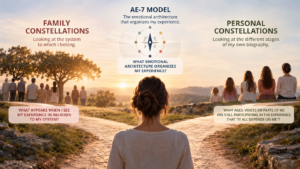
The AE-7 Model explores the emotional architecture that may be organizing our experience.
We can broaden this investigation in two other complementary directions:
toward the system we belong to, through Family Constellations, and toward the different stages of our own biography, through Personal Constellations.
The three perspectives begin from different angles and explore different dimensions of the same experience.
PC-32-En · AE-7 MODEL
Explores the emotional architecture that may be organizing the experience.
WHAT EMOTIONAL ARCHITECTURE IS ORGANIZING MY EXPERIENCE?
PC-32-A-En · FAMILY CONSTELLATIONS
Broadens the perspective toward the system we belong to.
WHAT APPEARS WHEN I OBSERVE MYSELF IN RELATION TO MY SYSTEM?
Continue → PC-32-A-En — “To Be Safe, I Can’t Upset Others” Through Family Constellations
PC-32-B-En · PERSONAL CONSTELLATIONS
Broadens the perspective toward the different stages of our own biography.
WHAT APPEARS WHEN I OBSERVE MY DIFFERENT AGES AND THE RELATIONSHIP BETWEEN THEM?
Continue → PC-32-B-En — “To Be Safe, I Can’t Upset Others” Through Personal Constellations
None of these perspectives needs to invalidate the others.
Each allows us to explore a different dimension of the experience.