
AE-7 Map – 11-Audios – AE-7 Model – 33 Cases – 105 Cases
Versión en español (castellano) >>>
The AE-7 Therapy Model
Versión en Español (Castellano)
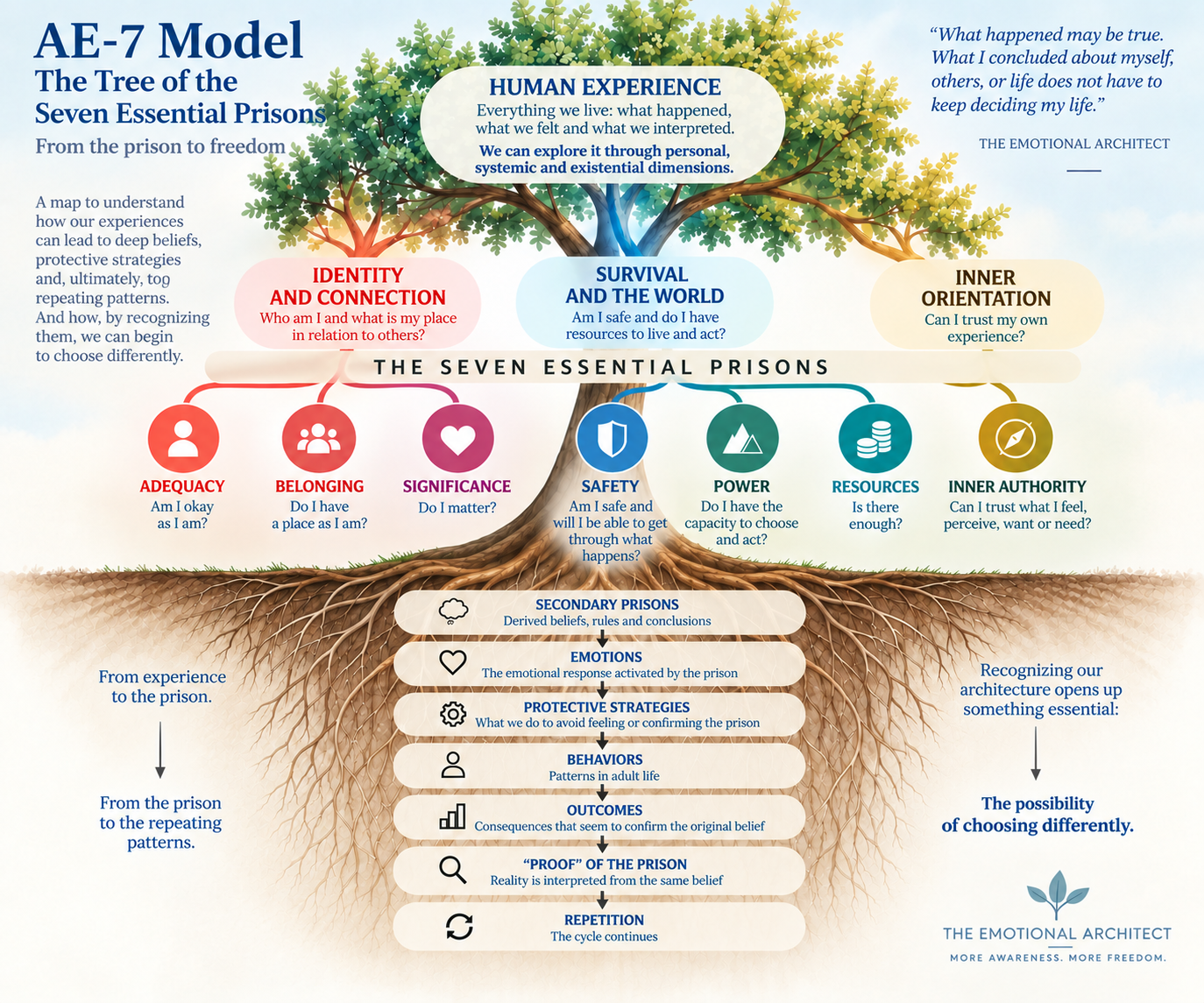
AE-7 Model — The Tree Of The 7 Essential Prisons
Emotional Architecture Model
The AE-7 Model was developed by Angel Primal (Ángel Álvarez), Primal therapist and Family Constellations facilitator.
It is a model primarily inspired by the work of Peter Crone, particularly by his way of exploring the unconscious beliefs that organize our perception of ourselves, others, and life.
One fundamental idea that Angel Primal shares with Peter Crone is that suffering does not arise only from what happened, but from the meaning we give to what happened and the conclusions we often unconsciously form about our identity, our safety, our place in the world, or our ability to trust our own experience.
Peter Crone has described broad domains such as inadequacy, insecurity, and scarcity, and uses reverse engineering to move from present-day behaviors, emotions, and difficulties toward the deeper beliefs that may be organizing them.
The Emotional Architect model begins with this inspiration but develops an architecture of its own.
The analysis of recurring patterns observed across numerous therapeutic processes and cases suggests that some experiences cannot be fully understood through inadequacy, insecurity, or scarcity alone.
Other dimensions repeatedly emerge involving belonging, significance, the capacity to choose, and especially inner authority over our own experience: the ability to recognize what we feel, perceive, need, or want without depending entirely on external validation.
A MODEL OPEN TO DIFFERENT DIMENSIONS OF EXPERIENCE
The AE-7 Model focuses primarily on exploring how an experience acquires meaning and how that meaning may continue to organize our lives.
But human experience can be viewed from different levels.
We can explore our personal history and the conclusions we formed from it.
We can broaden our perspective toward our family system, observing relationships, events, and dynamics that may extend beyond strictly individual experience. Sometimes, this exploration can reach back through multiple generations, allowing us to investigate how ancestral patterns may still participate in our present experience: Ancestral Healing.
And we can also explore an existential or spiritual dimension: what broader meaning our experiences may acquire, and how our limitations may become an opportunity to develop greater awareness and freedom.
AE-7 does not attempt to establish which of these perspectives contains the ultimate explanation of our experience.
Its purpose is to provide a map that allows us to explore:
WHAT AM I EXPERIENCING?
↓
WHAT DOES IT MEAN TO ME?
↓
WHAT CONCLUSION MAY BE ORGANIZING MY EXPERIENCE?
↓
HOW AM I TRYING TO PROTECT MYSELF FROM IT?
↓
WHAT POSSIBILITY FOR GREATER FREEDOM EMERGES WHEN IT NO LONGER AUTOMATICALLY DECIDES FOR ME?
WE DO NOT NEED TO KNOW THE ULTIMATE ORIGIN OF AN EXPERIENCE IN ORDER TO DISCOVER WHAT IT MAY BE REVEALING AND WHAT POSSIBILITY FOR TRANSFORMATION IT MAY OPEN.
THE LAYERS OF EMOTIONAL ARCHITECTURE
The AE-7 Model distinguishes between:
essential prisons,
secondary or derived prisons,
emotions,
protective strategies,
and
adult behaviors.
This distinction prevents us from treating every limiting belief as though it existed at the same level.
A statement such as:
“I HAVE TO DO IT PERFECTLY”
may be a strategy developed to avoid feeling:
“I am not enough.”
“If I fail, they will stop loving me.”
“If I make a mistake, I will lose safety.”
or even:
“If I don’t do things right, I have no right to trust my own judgment.”
The same behavior can arise from completely different roots.
THE SELF-CONFIRMING CYCLE
The AE-7 Model places particular emphasis on the self-confirming cycle of the prison:
EVENT / EXPERIENCE
↓
INTERPRETATION / MEANING
↓
PRISON
↓
EMOTION
↓
PROTECTIVE STRATEGY
↓
BEHAVIOR
↓
OUTCOME
↓
“PROOF” OF THE ORIGINAL BELIEF
↓
REPETITION
The therapeutic goal is not simply to replace a negative belief with a positive one.
It is to discover how the interpretation was formed, distinguish the event from the conclusion we drew from it, recognize the strategy that developed to protect us, and create new experiences that are no longer automatically governed by that conclusion.
The central idea can be summarized as:
WHAT HAPPENED MAY HAVE BEEN TRUE.
WHAT I CONCLUDED ABOUT MYSELF, OTHERS, OR LIFE DOES NOT HAVE TO REMAIN TRUE.
From this perspective, Emotional Architect does not seek to reproduce Peter Crone’s model, but rather to continue a similar line of inquiry and develop it through its own therapeutic structure, built from the analysis of recurring patterns, therapeutic cases, and processes of emotional reverse engineering.
Peter Crone is therefore the primary inspiration for the model.
However, the Tree of the Seven Essential Prisons, the derived prisons, the self-confirming cycle, and the inclusion of Inner Authority as a fundamental dimension are specific developments of Emotional Architect.
AE-7 MODEL
THE TREE OF THE SEVEN ESSENTIAL PRISONS
Human beings can develop hundreds of beliefs, fears, internal rules, and protective strategies.
But they do not all exist at the same level.
One person may think:
“I have to do it perfectly.”
Another:
“I can’t disappoint you.”
Another:
“I need to know what’s going to happen.”
Another:
“If I don’t have proof, maybe I’m overreacting.”
On the surface, these appear to be different prisons.
But through reverse engineering, we can ask:
What are you trying to avoid?
What would happen if you did the opposite?
What would that mean to you?
And if that were true, what would it say about you, others, or life?
When we go deep enough, many prisons begin to cluster around a much smaller number of fundamental conclusions.
We call these conclusions:
ESSENTIAL PRISONS
And the beliefs subsequently built around them:
SECONDARY OR DERIVED PRISONS
THE THREE LAYERS OF THE MODEL
1. ESSENTIAL PRISON
It is a deep conclusion about:
WHO I AM
WHAT PLACE I HAVE
WHAT I CAN EXPECT FROM LIFE
or
WHAT I CAN TRUST.
Example:
“I DON’T MATTER.”
2. DERIVED PRISON
It is a conclusion developed in order to live within that reality.
For example:
“If I’m not useful, they will stop choosing me.”
“I don’t want to cause problems.”
“I have to be available.”
All of these may be attempts to resolve:
“I DON’T MATTER.”
3. PROTECTIVE STRATEGY
It is what the person does to avoid feeling or confirming the prison.
For example:
being useful
always being available
anticipating other people’s needs
not asking
taking care of everyone
making oneself indispensable
These are not the prison.
THEY ARE ATTEMPTS TO ESCAPE FROM IT.
THE COMPLETE ARCHITECTURE
EXPERIENCE
↓
MEANING
↓
ESSENTIAL PRISON
↓
DERIVED PRISON
↓
EMOTION
↓
PROTECTIVE STRATEGY
↓
BEHAVIOR / ADAPTIVE PERSONALITY
↓
OUTCOME
↓
“PROOF” OF THE ORIGINAL PRISON
↓
REPETITION
The initial experience may have been real.
The conclusion we formed about ourselves, others, or life does not have to remain a valid description of our present reality.
THE THREE MAJOR TERRITORIES
The seven essential prisons are organized into three major territories of human experience:
I. IDENTITY AND CONNECTION
- ADEQUACY
- BELONGING
- SIGNIFICANCE
II. SURVIVAL AND THE WORLD
- SAFETY
- POWER
- RESOURCES
III. INNER ORIENTATION
- INNER AUTHORITY
🌳 AE-7 MODEL: FROM THE TREE TO FREEDOM
Under each root are numerous secondary prisons.
And beneath them are the strategies we use to protect ourselves.
ROOT 1 — ADEQUACY
Fundamental Question
“AM I OKAY AS I AM?”
Essential Prison
“I AM NOT OKAY AS I AM.”
This root includes the experience that something about me is insufficient, wrong, or defective.
It can move in two different directions.
LACK
I am not enough.
DEFECT
There is something wrong with me.
From there, derived prisons may emerge:
I’m not good enough.
I’m a failure.
I’m incompetent.
I’m worthless.
I’m bad.
I don’t deserve.
I’m not special.
I have to prove my worth.
I can’t allow myself to make mistakes.
I have to be perfect.
If I acknowledge my worth, I’ll be arrogant.
Common Strategies
PROVING · PERFECTING · PERFORMING · COMPARING · HIDING FLAWS · SELF-CORRECTING · SELF-PUNISHING · SEEKING VALIDATION
The adult pattern may become:
“I HAVE TO BECOME SOMEONE BETTER IN ORDER TO BE OKAY WITH MYSELF.”
ROOT 2 — BELONGING
Fundamental Question
“DO I HAVE A PLACE AS I AM?”
Essential Prison
“I DO NOT HAVE A PLACE AS I AM.”
This root includes love, acceptance, rejection, abandonment, and authenticity.
Derived prisons may include:
I am not loved.
I am not lovable.
I am not accepted as I am.
I am not wanted.
I don’t belong.
They don’t want me here.
If they really know me, they will reject me.
People eventually leave.
I don’t want you to know how much I care about you.
If I need you too much, you’ll have power over me.
If I need space, you’ll think I don’t love you anymore.
If I say what I really want, we may discover that we’re incompatible.
I have to become what you need.
Common Strategies
PLEASING · ADAPTING · CAMOUFLAGING · SEDUCING · BECOMING INDISPENSABLE · NOT BEING A BURDEN · CLINGING · CHECKING THE BOND · LEAVING BEFORE BEING REJECTED
Two apparently opposite personalities can emerge from the same root:
ANXIETY
“Don’t leave me.”
or:
AVOIDANCE
“I don’t need anyone.”
The underlying prison may be:
“NEEDING YOU PUTS MY PLACE AT RISK.”
ROOT 3 — SIGNIFICANCE
Fundamental Question
“DO I MATTER?”
Essential Prison
“I DON’T MATTER.”
Here, the problem is not necessarily:
“There is something wrong with me.”
Nor:
“They don’t love me.”
It may be:
“WHAT HAPPENS TO ME CARRIES LESS WEIGHT.”
Derived prisons may include:
My needs don’t matter.
My feelings don’t matter.
I’m invisible.
No one thinks about me.
I don’t want to cause problems.
I have to take care of others.
If I’m not useful, they’ll stop choosing me.
I should know what you need before you ask me.
I can’t be okay if you’re not okay.
I have to be available so they keep including me.
Common Strategies
CARING FOR OTHERS · FIXING · ANTICIPATING · GIVING · SILENCING NEEDS · NOT ASKING · BECOMING HYPER-RESPONSIBLE · MAKING ONESELF INDISPENSABLE
A paradox may emerge:
“I MAKE MYSELF INDISPENSABLE IN ORDER TO FEEL THAT I MATTER.”
But the less a person expresses their needs, the fewer opportunities others have to respond to them.
Then the person concludes:
“SEE? NO ONE IS REALLY THERE FOR ME.”
ROOT 4 — SAFETY
Fundamental Question
“AM I SAFE, AND WILL I BE ABLE TO GET THROUGH WHAT HAPPENS?”
Essential Prison
“I AM NOT SAFE.”
It has two major branches.
THREAT
“SOMETHING BAD MAY HAPPEN.”
ANTICIPATED INABILITY TO COPE
“IF IT HAPPENS, I WON’T BE ABLE TO HANDLE IT.”
Derived prisons may include:
I never know what’s going to happen.
I have to stay alert.
I can’t trust life.
I can’t fully trust other people.
When everything is going well, something bad is going to happen.
If I stop worrying, I’ll let my guard down.
It’s better not to get too excited.
If I feel afraid, something must be wrong.
I need to be completely certain before I decide.
If I stop being angry, they’ll hurt me again.
Common Strategies
CONTROLLING · PLANNING · PREDICTING · CHECKING · WORRYING · AVOIDING · STAYING ALERT · NOT DELEGATING · LOWERING EXPECTATIONS
The adult pattern:
“IF I CAN CONTROL REALITY ENOUGH, I WILL BE SAFE.”
But the more certainty a person needs, the less tolerable any uncertainty becomes.
ROOT 5 — POWER
Fundamental Question
“DO I HAVE THE CAPACITY TO CHOOSE AND ACT?”
Essential Prison
“I DO NOT HAVE THE CAPACITY TO CHOOSE.”
It may be expressed as:
I have no power.
I have no choice.
I’m trapped.
I can’t change this.
Other people decide for me.
I have to do it.
I have no other option.
And it can generate other derived prisons:
If I’ve already said yes, I can’t change my mind now.
If I stand up for myself, I’m being confrontational.
If someone gets upset about my boundary, maybe my boundary is unfair.
If I accept help, I lose autonomy.
If I clearly see what’s happening, I’ll have to do something.
Common Strategies
It may produce:
SUBMISSION · RESIGNATION · PASSIVITY
but also its opposite:
REBELLION · DOMINANCE · CONTROL · REJECTION OF ALL AUTHORITY
Because someone who experienced powerlessness may construct:
“I WILL NEVER AGAIN ALLOW ANYONE TO HAVE POWER OVER ME.”
The underlying pattern may still be the same.
ROOT 6 — RESOURCES
Fundamental Question
“IS THERE ENOUGH?”
Essential Prison
“THERE IS NOT ENOUGH.”
And its second expression:
“I CAN LOSE WHAT I HAVE.”
Derived prisons may include:
It’s never enough.
I need more.
I can’t relax yet.
I have to accumulate.
I have to keep producing.
If I rest, I may fall behind.
If I allow myself to enjoy life, I’ll lose my drive.
If it doesn’t cost me something, it has no value.
Common Strategies
ACCUMULATING · OVERWORKING · COMPETING · HOLDING ON · NOT RESTING · SECURING · MEASURING · COMPARING
The promise is usually:
“WHEN I HAVE ENOUGH, I’LL BE ABLE TO RELAX.”
But the definition of “enough” keeps moving.
ROOT 7 — INNER AUTHORITY
This is a particularly important element of the AE-7 Model.
Fundamental Question
“CAN I TRUST MY OWN EXPERIENCE?”
Essential Prison
“I CANNOT TRUST WHAT I FEEL, PERCEIVE, WANT, OR NEED WITHOUT EXTERNAL VALIDATION.”
This root does not primarily ask:
“Am I worthy?”
Nor:
“Do they love me?”
It asks:
“DO I HAVE THE AUTHORITY TO RECOGNIZE MY OWN EXPERIENCE?”
Here we find some of the most subtle prisons:
I don’t know what I want.
If I can’t explain why it bothers me, maybe it shouldn’t bother me.
If I feel bad, something must be wrong.
I need you to understand why I did what I did.
I need you to acknowledge that I have a point.
If I can’t say it perfectly, I’d better say nothing.
If you didn’t intend it, maybe I don’t have the right to say that it hurt me.
If someone gets upset about my boundary, maybe my boundary is unfair.
If I feel guilty, I must have done something wrong.
If someone criticizes me, I have to decide whether they’re right or wrong.
If it still affects me, it means I haven’t gotten over it.
If I can’t prove it, I don’t have the right to trust what I perceive.
My feelings don’t matter.
If I want two contradictory things, I don’t know what I want.
Common Strategies
ANALYZING · JUSTIFYING · EXPLAINING · ASKING FOR OPINIONS · SEEKING PROOF · CHECKING · RATIONALIZING · SELF-INVALIDATING · SEEKING EXTERNAL VERDICTS · WAITING FOR CERTAINTY
Here, the person hands over something fundamental:
THE AUTHORITY TO RECOGNIZE THEIR OWN EXPERIENCE.
THIS SEVENTH ROOT IS A PARTICULARLY DISTINCTIVE FEATURE OF THE MODEL
We can feel something without it automatically being an external fact.
We can perceive something without automatically turning it into truth.
We can need something without others being obligated to provide it.
We can want something without necessarily having to act on it.
We can set a boundary without proving that the other person is guilty.
Therefore:
EMOTION ≠ VERDICT.
But also:
EMOTION ≠ GARBAGE.
PERCEPTION ≠ PROOF.
But also:
PERCEPTION ≠ IRRELEVANCE.
GUILT ≠ GUILTINESS.
DOUBT ≠ ERROR.
DISCOMFORT ≠ DANGER.
CRITICISM ≠ DEFINITION OF IDENTITY.
DESIRE ≠ DECISION.
Here we recover:
INNER AUTHORITY WITHOUT INFALLIBILITY.
BRIDGE PRISONS
Not every belief belongs exclusively to one root.
Some function as bridges.
For example:
“I CAN’T TRUST ANYONE.”
may arise from:
SAFETY
“People are dangerous.”
or from:
BELONGING
“If I depend on someone, they’ll eventually abandon me.”
or from:
POWER
“If I trust, I give up power.”
This is why the model does not use these categories as rigid diagnoses.
The goal is always to ask:
“WHAT DOES THIS MEAN TO THIS PERSON?”
PRISONS CAN ALSO BE EXPLORED THROUGH A FAMILY AND SYSTEMIC DIMENSION
AE-7 begins primarily with the person’s experience:
WHAT DID I EXPERIENCE?
WHAT DID IT MEAN TO ME?
WHAT DID I CONCLUDE?
HOW DID I LEARN TO PROTECT MYSELF?
But our experience does not occur in isolation.
We are born into a family, a history, and a system of relationships that existed before we arrived.
Through the perspective of Family Constellations, we can broaden the exploration and observe how certain fears, responsibilities, ways of relating, or ways of taking our place may be connected to family events and dynamics.
During a Constellation, representatives may experience bodily sensations, emotions, impulses, orientations, or movements that do not arise from conscious knowledge of the history of the people they represent.
This phenomenon has been interpreted in different ways and may be described using concepts such as field, resonance, systemic information, or energetic connection.
AE-7 does not need to establish the mechanism that produces this experience.
In Constellation work, we adopt a fundamentally phenomenological position:
WE OBSERVE WHAT EMERGES.
We do not need to decide beforehand what it means.
We do not need to assume that it comes from an ancestor.
We do not need to make the system confirm our interpretation.
WE PLACE → WE OBSERVE → WE MAKE A MOVEMENT → WE OBSERVE AGAIN → WE INCLUDE ONLY WHAT IS NECESSARY
A person may experience, for example:
“I don’t have the right to have more than others.”
“If I do too well, I betray my family.”
“I have to take care of everyone.”
“I can’t leave my family.”
“I have to be strong.”
“I don’t have the right to be happy if they suffered.”
AE-7 can explore these experiences through reverse engineering.
And the systemic perspective can open another avenue of exploration:
PERSONAL EXPERIENCE
and also, when relevant,
FAMILY SYSTEM
↓
MEANING
↓
PRISON
↓
PROTECTIVE STRATEGY
↓
REPEATING PATTERN
The goal is not to assume that every current problem comes from our ancestors or to turn a systemic hypothesis into certainty.
It is about broadening our observation.
In some cases, we may clearly recognize an experience from our own history.
In others, relationships or movements connected to the family system may emerge and be worth exploring.
And in others, both dimensions may be present.
Becoming free does not mean rejecting our family or denying its history.
It may mean recognizing:
“I CAN HONOR WHAT THEY LIVED THROUGH WITHOUT NEEDING TO REPEAT IT.”
And learning to distinguish:
WHAT BELONGS TO MY STORY
from
WHAT MAY BE CONNECTED TO MY FAMILY SYSTEM.
THE MAP DOES NOT DECIDE WHERE THE EXPERIENCE COMES FROM. IT HELPS US EXPLORE IT.
AND WHAT ABOUT THE SPIRITUAL DIMENSION?
Peter Crone introduces into his work a dimension that goes beyond the psychological exploration of our beliefs.
In some of his teachings, he views human experience as an opportunity to recognize and transcend our limitations and reach greater freedom, also using concepts such as energy, vibration, and frequency.
AE-7 shares with Peter Crone, in particular, the exploration of what limits our freedom, but it does not need to establish a metaphysical explanation for the origin of those limitations.
For example, AE-7 does not need to assert:
“MY SOUL CHOSE THIS EXPERIENCE SO I COULD LEARN SOMETHING.”
But neither does it need to assert the opposite.
The question can remain open:
“WHAT CAN THIS EXPERIENCE REVEAL TO ME ABOUT WHAT I AM STILL NOT FREE FROM?”
We can explore the psychological meaning of an experience while also allowing each person to find — or not find — a broader existential or spiritual meaning.
These are different levels:
PSYCHOLOGICAL
What meaning did I construct?
↓
SYSTEMIC
What emerges when I broaden my perspective toward the system I belong to?
↓
EXISTENTIAL / SPIRITUAL
What can this experience reveal to me about my path toward greater freedom?
AE-7 does not need to make any spiritual interpretation a requirement of the therapeutic process.
WE CAN WORK WITH THE MEANING OF AN EXPERIENCE WITHOUT NEEDING TO SOLVE THE MYSTERY OF WHY IT HAPPENED.
ANOTHER EXAMPLE
“I HAVE TO BE PERFECT.”
may arise from:
ADEQUACY
“If I fail, it means I’m not good enough.”
BELONGING
“If I fail, they’ll stop loving me.”
SIGNIFICANCE
“I only matter when I do things well.”
SAFETY
“Mistakes have dangerous consequences.”
Behavior does not automatically reveal the root.
CENTRAL PRINCIPLE OF THE AE-7 MODEL
WE DO NOT REVERSE-ENGINEER BEHAVIOR INTO A PREDETERMINED BELIEF.
We reverse-engineer:
FROM THE BEHAVIOR TO THAT PERSON’S PARTICULAR MEANING.
This is why two people may display exactly the same behavior while protecting themselves from completely different prisons.
HOW DO WE KNOW IF WE HAVE FOUND AN ESSENTIAL PRISON?
We can use five criteria.
1. IT IS TRANSVERSAL
It appears across different areas of life.
Not merely:
“I’m not good at playing tennis.”
But:
“There is something about me that is never quite enough.”
2. IT IS IDENTITY-BASED OR EXISTENTIAL
It speaks to:
WHO I AM
WHAT PLACE I HAVE
WHETHER I AM SAFE
WHETHER I CAN ACT
WHETHER RESOURCES ARE AVAILABLE
or
WHETHER I CAN TRUST MY OWN EXPERIENCE.
3. IT EXPLAINS SEVERAL SECONDARY PRISONS
A strong root organizes many branches.
For example:
“I DO NOT HAVE A PLACE AS I AM.”
may explain:
I don’t want to disappoint you.
I don’t want to cause problems.
I have to adapt.
I don’t want you to know how much I care about you.
I’d rather not ask in case they say no.
4. IT EXPLAINS THE FUNCTION OF THE STRATEGY
We ask:
“WHAT DOES DOING THIS PROTECT YOU FROM?”
If the answer explains why the person controls, pleases, proves, avoids, or checks, we are probably close to the root.
5. WHEN WE REACH IT, THE NATURE OF THE QUESTION CHANGES
Example:
“I have to do it perfectly.”
Why?
“Because if I fail, they’ll think I’m not competent.”
And what would that mean?
“That maybe I’m really not good enough.”
We could keep asking forever.
But therapeutically, we have already reached:
ADEQUACY.
The next step is not to find an even more dramatic statement.
It is to explore:
WHEN DID I LEARN TO SEE MYSELF THIS WAY?
And, when relevant, we can broaden our observation toward the family system without assuming in advance that we will find the cause there.
THE TREE OF STRATEGIES
The seven roots can generate hundreds of strategies, but many of them can be grouped into eight protective movements:
1. PROVE
“I’m going to prove that I’m worthy.”
2. PLEASE
“I’m going to make you love me.”
3. MAKE MYSELF NECESSARY
“I’m going to make sure you need me.”
4. CONTROL
“I’m going to prevent the dangerous thing from happening.”
5. AVOID
“I won’t expose myself to anything that might confirm my prison.”
6. CHECK
“I’m going to seek certainty before I trust.”
7. ACCUMULATE
“I’m going to get enough so I can feel safe.”
8. DISAPPEAR / MAKE MYSELF SMALLER
“If I take up less space, it will be harder to reject me.”
These strategies can overlap.
COMPLETE EXAMPLE 1
An emotionally distant father.
↓
The child interprets:
“He’s not there for me because I’m not important.”
↓
ESSENTIAL PRISON
I DON’T MATTER.
↓
DERIVED PRISON
MY NEEDS DON’T MATTER.
↓
RULE
I SHOULDN’T NEED TOO MUCH.
↓
STRATEGY
BE SELF-SUFFICIENT.
↓
PERSONALITY
“I can handle everything.”
↓
ADULT RELATIONSHIP
Doesn’t ask.
↓
The partner doesn’t know what they need.
↓
Receives little support.
↓
OUTCOME
“In the end, no one is there for me.”
↓
CONFIRMATION
I DON’T MATTER.
🔁
COMPLETE EXAMPLE 2
A child receives affection mainly when they achieve good results.
↓
Interprets:
“Doing well keeps me connected.”
↓
ESSENTIAL PRISON
I AM NOT OKAY AS I AM.
↓
DERIVED PRISON
I HAVE TO PROVE MY WORTH.
↓
STRATEGY
PERFECTIONISM.
↓
SUCCESS.
↓
TEMPORARY RELIEF.
↓
NEW GOAL.
↓
FEAR OF FAILURE.
↓
“IT’S STILL NOT ENOUGH.”
🔁
COMPLETE EXAMPLE 3
An unpredictable childhood.
↓
ESSENTIAL PRISON
I AM NOT SAFE.
↓
DERIVED PRISON
I HAVE TO KNOW WHAT’S GOING TO HAPPEN.
↓
STRATEGY
CONTROL / PLANNING.
↓
The person avoids uncertainty.
↓
They never discover:
“I can also respond when something wasn’t planned.”
↓
Their tolerance for uncertainty decreases.
↓
“SEE? I CAN’T BE OKAY UNLESS I’M IN CONTROL.”
🔁
COMPLETE EXAMPLE 4
An emotion was repeatedly minimized.
↓
The person learns:
“MY INNER EXPERIENCE IS NOT RELIABLE ENOUGH.”
↓
Derived prison:
“I need an objective reason to be upset.”
↓
Strategy:
ANALYZE.
↓
Minimizes.
↓
Doesn’t express it.
↓
The boundary becomes invisible.
↓
The situation continues.
↓
Resentment builds.
↓
Eventually explodes.
↓
“SEE? MY FEELINGS CREATE PROBLEMS.”
🔁
This fourth example shows why INNER AUTHORITY deserves a root of its own within the model.
THE THERAPEUTIC GOAL IS NOT TO INSTALL THE OPPOSITE BELIEF
If we discover:
“I AM NOT ENOUGH”
we do not simply need to replace it with:
“I am enough.”
That may help.
But the deeper movement is:
“I AM OBSERVING A CONCLUSION I LEARNED ABOUT MYSELF.”
The person begins to distinguish:
EVENT
from
INTERPRETATION.
Then:
INTERPRETATION
from
IDENTITY.
And finally:
EMOTION
from
CHOICE.
THE SEVEN MOVEMENTS TOWARD FREEDOM
1. ADEQUACY
From:
“I HAVE TO PROVE WHO I AM.”
to:
“MY WORTH DOES NOT NEED TO BE RESOLVED THROUGH EVERY OUTCOME.”
2. BELONGING
From:
“I HAVE TO STOP BEING MYSELF IN ORDER TO KEEP YOU.”
to:
“I CAN DISCOVER WHERE I CAN BELONG WITHOUT ABANDONING MYSELF.”
3. SIGNIFICANCE
From:
“I HAVE TO BE USEFUL IN ORDER TO MATTER.”
to:
“MY NEEDS AND MY PRESENCE ARE ALSO PART OF THE RELATIONSHIP.”
4. SAFETY
From:
“I NEED TO GUARANTEE THAT NOTHING BAD WILL HAPPEN.”
to:
“I CAN PREPARE WITHOUT NEEDING TO CONTROL ALL OF LIFE.”
5. POWER
From:
“I HAVE NO CHOICE.”
to:
“I CAN EXPLORE WHAT MARGIN OF CHOICE STILL BELONGS TO ME.”
6. RESOURCES
From:
“WHEN I HAVE ENOUGH, I’LL BE ABLE TO LIVE.”
to:
“I CAN DISTINGUISH REAL NEED FROM THE ENDLESS SEARCH FOR SAFETY.”
7. INNER AUTHORITY
From:
“I NEED SOMEONE OR SOMETHING TO CONFIRM MY EXPERIENCE.”
to:
“I CAN LISTEN TO MYSELF, REALITY-CHECK, AND CHOOSE WITHOUT NEEDING TO BE INFALLIBLE.”
THE MOST IMPORTANT PRINCIPLE OF THE MODEL
FREEDOM DOES NOT MEAN MAKING THE PRISON STOP APPEARING.
A person may continue to feel:
fear, shame, guilt, doubt, anxiety, jealousy, or insecurity.
Transformation occurs when they can recognize:
“THIS IS APPEARING IN ME.”
without immediately turning it into:
“THIS IS THE TRUTH.”
Then a space appears.
Within that space, we can:
SEE
↓
DIFFERENTIATE
↓
DESCEND TO THE ROOT
↓
RECOGNIZE THE STRATEGY
↓
FEEL WITHOUT AUTOMATICALLY OBEYING
↓
RECOVER CHOICE
↓
ACT DIFFERENTLY
↓
CREATE A NEW EXPERIENCE
THE NEW EXPERIENCE IS ESSENTIAL
The model does not end with understanding.
Because we can understand perfectly:
“This comes from my childhood.”
and continue doing exactly the same thing.
The prison begins to weaken when lived information incompatible with it appears.
For example:
I SET A BOUNDARY
↓
THE OTHER PERSON GETS UPSET
↓
I TOLERATE THEIR UPSET
↓
THE RELATIONSHIP DOES NOT DISAPPEAR
↓
NEW EXPERIENCE:
“I CAN DISAPPOINT SOMEONE AND STILL HAVE A PLACE.”
Another:
I ASK FOR HELP
↓
I RECEIVE IT
↓
I DO NOT LOSE MY AUTONOMY
↓
NEW EXPERIENCE:
“NEEDING DOES NOT MAKE ME INCAPABLE.”
Another:
I MAKE A MISTAKE
↓
I CORRECT IT
↓
I DO NOT LOSE MY WORTH
↓
NEW EXPERIENCE:
“AN OUTCOME IS NOT A DEFINITION OF WHO I AM.”
THE CENTRAL THERAPEUTIC QUESTION
When facing any pattern:
“WHAT WOULD HAVE TO BE TRUE FOR THIS STRATEGY TO MAKE SENSE?”
Because the strategy almost always made sense within some learned reality.
Then:
“WHAT IS IT TRYING TO AVOID?”
Then:
“WHAT WOULD IT MEAN IF THAT HAPPENED?”
And finally:
“WHICH OF THE SEVEN ROOTS DOES THIS LEAD US TO?”
THE SEVEN QUESTIONS OF THE EMOTIONAL ARCHITECT
1. AM I OKAY AS I AM?
ADEQUACY
2. DO I HAVE A PLACE AS I AM?
BELONGING
3. DO I MATTER?
SIGNIFICANCE
4. AM I SAFE, AND WILL I BE ABLE TO GET THROUGH WHAT HAPPENS?
SAFETY
5. DO I HAVE THE CAPACITY TO CHOOSE AND ACT?
POWER
6. IS THERE ENOUGH?
RESOURCES
7. CAN I TRUST MY OWN EXPERIENCE?
INNER AUTHORITY
These seven questions form the heart of the:
AE-7 MODEL
THE TREE OF THE SEVEN ESSENTIAL PRISONS
And the shared movement of transformation can be expressed like this:
WHAT HAPPENED MAY BE TRUE.
WHAT I CONCLUDED ABOUT MYSELF, OTHERS, OR LIFE DOES NOT HAVE TO KEEP DECIDING MY LIFE.
A NOTE ABOUT THE MODEL
The AE-7 Model is a conceptual map for therapeutic work and self-inquiry.
AE-7 distinguishes between what we can explore within personal experience, what may emerge within a systemic exploration, and the existential or spiritual interpretations each person may give to their experience.
The model does not seek to prove the existence of energetic fields, establish the mechanism through which phenomena observed in Family Constellations occur, or determine whether our experiences arise from decisions made by the soul, destiny, or a prior purpose.
These possibilities can be explored without needing to turn them into mandatory explanations.
AE-7 also does not claim that all human behavior can be mechanically reduced to seven causes, nor does it replace psychological or psychiatric assessment when such assessment is necessary.
A prison may belong to several roots.
The same experience may produce different meanings.
And two people displaying identical behavior may be protecting themselves from completely different conclusions.
For this reason, the tree does not tell the person what their root is.
It helps us ask better questions until they can discover it.
THE MAP GUIDES.
THE PERSON REVEALS THE MEANING.
THE 5 LEVELS OF HEALING
The AE-7 Emotional Architect Model is part of a broader view of the human experience: the 5 Bodies or Levels of Healing Model.
Our work with AE-7 takes place primarily across Levels 3, 4, and 5:
Level 3 · Mental and Emotional — where we explore emotional architecture, the conclusions we have formed, and the strategies that may continue to shape our lives.
Level 4 · Transpersonal — where Family Constellations broaden our perspective toward our systems and relationships.
HOW CAN A FAMILY PATTERN CONTINUE?
When we notice that an experience seems to repeat across generations, we do not need to immediately conclude that there is a transgenerational cause.
Sometimes we can recognize a more observable sequence:
AN EXPERIENCE CHANGES THE WAY A PERSON PERCEIVES, FEELS, OR RELATES TO OTHERS
↓
THAT WAY OF RELATING INFLUENCES THEIR CHILDREN
↓
THE CHILDREN ADAPT TO THAT ENVIRONMENT
↓
SOME OF THOSE ADAPTATIONS MAY CONTINUE INTO THEIR ADULT LIVES
↓
THE PATTERN MAY APPEAR AGAIN IN THE NEXT GENERATION
But this is only one possibility.
Family Constellations allow us to broaden our observation and ask:
WHAT EMERGES WHEN I OBSERVE MYSELF IN RELATION TO THE SYSTEM I BELONG TO?
We are not trying to prove that the origin necessarily lies with our ancestors.
We observe what emerges.
Nor are we looking only for what needs to be transformed.
A family can transmit fears and adaptations, but also strengths, abilities, resources, and ways of navigating life.
The question then becomes more than simply:
WHAT AM I REPEATING?
It expands to:
WHAT HAVE I RECEIVED?
WHAT DO I WANT TO KEEP?
WHAT DO I WANT TO DEVELOP?
AND WHAT CAN I STOP REPEATING?
Level 5 · Spiritual — where the work opens a space for a deeper and more personal dimension of experience that belongs to each individual.
DIFFERENT LEVELS. ONE HUMAN EXPERIENCE.