
AE-7 Map – 11 Audio – AE-7 Model – 3 Cases – 33 Cases – 105 Cases – Book I – Training
3 REAL CASES TO UNDERSTAND THE AE-7 MODEL
Versión en español (castellano) >>>
PC-7 — “Everything is Up to Me”
What might lie behind the need to take responsibility, solve problems, and hold everything together?
We will explore how a genuine strength—being responsible, resourceful, and independent—can also become a strategy when we feel that we cannot afford to let go, receive support, or depend on anyone.
→ AE-7 ANALYSIS — PC-7
→ FAMILY CONSTELLATIONS — PC-7-A
→ PERSONAL CONSTELLATIONS — PC-7-B
PC-11 — “I Am Not Enough”
What happens when our lives are dominated by “I should,” “I have to,” perfectionism, and relentless self-demands?
We will investigate the difference between wanting to grow and constantly trying to become a better version of ourselves because, somewhere within our experience, we feel:
“I am not enough as I am.”
→ AE-7 ANALYSIS — PC-11
→ FAMILY CONSTELLATIONS — PC-11-A
→ PERSONAL CONSTELLATIONS — PC-11-B
PC-32 — “To Feel Safe, I Must Not Upset Others”
What lies behind people-pleasing, adapting to others, avoiding conflict, staying silent, or trying to make sure everyone is okay?
We will explore when being considerate of others stops being simply a positive quality and may become a strategy for preserving safety, connection, or acceptance.
→ AE-7 ANALYSIS — PC-32
→ FAMILY CONSTELLATIONS — PC-32-A
→ PERSONAL CONSTELLATIONS — PC-32-B
THREE PERSPECTIVES ON THE SAME EXPERIENCE
From the AE-7 Model, we ask:
WHAT EMOTIONAL ARCHITECTURE IS SHAPING MY EXPERIENCE?
From the perspective of Family Constellations:
WHAT EMERGES WHEN I OBSERVE MYSELF IN RELATION TO MY FAMILY SYSTEM?
And from the perspective of Personal Constellations:
WHAT EMERGES WHEN I OBSERVE MYSELF AT DIFFERENT AGES AND THE RELATIONSHIPS BETWEEN THOSE STAGES OF MY LIFE?
We are not looking for one perspective to necessarily confirm the others. Each opens a different space for observation.
THE MAP PROVIDES DIRECTION.
THE PERSON REVEALS THE MEANING.
3 CASES TO BEGIN YOUR TRAINING
1. OBSERVE THE CASE
Read the experience presented and distinguish what the person actually expresses from the interpretations that might arise.
2. CHOOSE WHAT YOU WOULD ASK
Before discovering the analysis, decide which question you would use to open the inquiry.
3. EXPLORE THE ANALYSIS
Explore possible connections between experiences, meanings, essential roots, strategies, and protective functions.
4. COMPARE POSSIBILITIES
Observe what each question might help investigate, what new perspectives it opens, and what precautions are worth keeping in mind.
5. REFLECT AS A FACILITATOR
Recognize your own hypotheses, potential biases, and alternative ways of supporting the person. Pay attention to their strengths and resources as well.
The goal is not to get the right answer. The goal is to learn how to investigate.
BEGIN YOUR TRAINING
Select one of the three PC Cases and explore the different possibilities offered by the interactive laboratory.
ACCESS THE AE-7 INTERACTIVE LABORATORY
How to Use the AE7 Application
Access the Free App for Android and iPhone: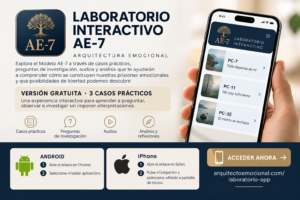 Laboratorio App para Android >>>
Laboratorio App para iPhone >>>
EMOTIONAL ARCHITECT · AE-7 MODEL
AE-7 INTERACTIVE LABORATORY
Learn to investigate without imposing an interpretation. Select a case, choose a path of inquiry, and discover questions that may open new possibilities.
EXPLORE THE AE-7 QUESTION BANK →

AUDIOS DE LOS 3 CASOS PC, PASO A PASO
Un recorrido guiado por sus preguntas, análisis y posibilidades.
Caso PC-7 · Todo depende de mí
Audio 1: Experiencia inicial y familias A y B
Audio 2: Familias C, D y E; comparación de intervenciones y reflexión del facilitador
Caso PC-11 · Estoy atascada
Audio 3: Experiencia inicial y familias A y B.
Audio 4: Familias C, D y E; comparación de intervenciones y reflexión del facilitador.
Caso PC-32 · Agradar y no molestar
Audio 5: Experiencia inicial y familias A y B.
Audio 6: Familias C, D y E; comparación de intervenciones y reflexión del facilitador.
Audio 7 · Tres casos, tres arquitecturas emocionales
Una reflexión comparativa sobre las diferencias entre los tres casos, las preguntas que pueden abrir perspectivas distintas y lo que aprende el facilitador.