
Question Bank · Free Laboratory · Advanced Laboratory · Advanced Questions
PRACTICAL TRAINING: 3 FREE ACCESS CASES
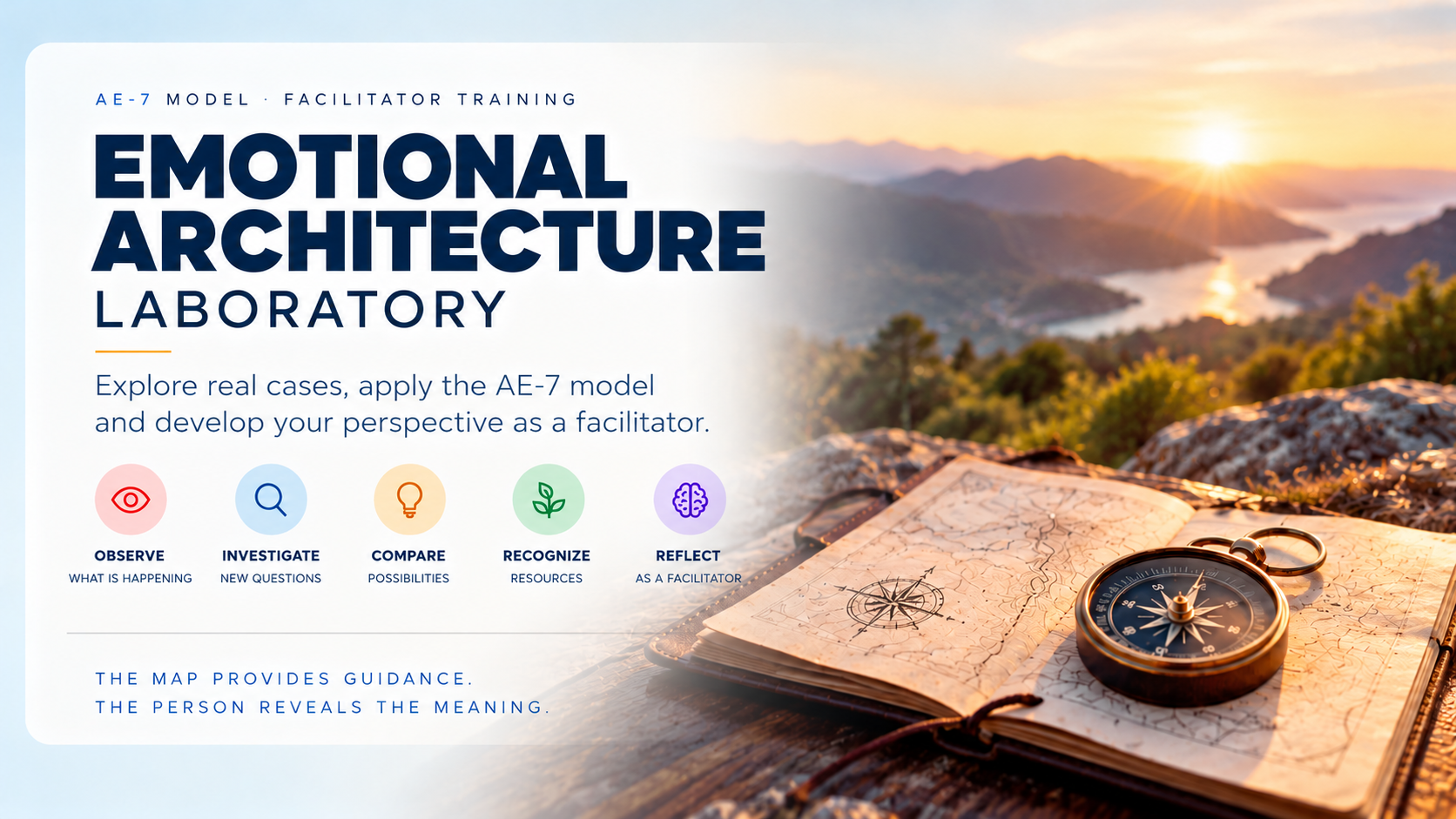
AE-7 MODEL · PUBLIC LABORATORY
🎧 PREFER TO LISTEN?
Welcome to a free, interactive, hands-on training space for those who wish to explore the AE-7 Model and develop their investigation and facilitation skills.
Through three PC Cases, you can step into the role of the facilitator, observe an experience, choose what you would ask before seeing the analysis, and compare different possibilities for intervention.
The purpose is not to find the correct answer or learn ready-made interpretations.
It is to develop an approach to facilitation based on listening, curiosity, discernment, and respect for each person’s experience.
The same behavior can have different meanings. A strategy may be trying to protect something important. And a capacity developed under difficult circumstances may remain a valuable resource.
Investigating does not mean confirming what we believe we already know. It means opening a space to discover what we do not yet understand.
THREE CASES TO GET STARTED
This laboratory offers three training experiences that introduce different forms of emotional architecture:
PC-7 · EVERYTHING DEPENDS ON ME
An opportunity to explore responsibility, self-imposed pressure, and the possible protective functions of taking responsibility for everything, without assuming what that behavior means.
PC-11 · I FEEL STUCK
An invitation to explore what may be happening when someone experiences difficulty moving forward, recognizing both their obstacles and their capacities.
PC-32 · PLEASING OTHERS AND NOT BEING A BURDEN
A case for investigating adaptation to others, the need for belonging, and the possibilities of expressing one’s own experience while recognizing the resources developed along the way.
Each case offers an opportunity to formulate questions, examine hypotheses, and broaden our understanding without reducing the person’s experience to a single explanation.
HOW DOES THE TRAINING WORK?
1. OBSERVE THE CASE
Read the experience presented and distinguish what the person actually expresses from the interpretations that may arise.
2. CHOOSE WHAT YOU WOULD ASK
Before revealing the analysis, decide which question you would use to open the investigation.
3. EXPLORE THE ANALYSIS
Explore possible connections between experiences, meanings, essential roots, strategies, and protective functions.
4. COMPARE POSSIBILITIES
Consider what each question may help investigate, what new perspectives it opens, and what precautions should be kept in mind.
5. REFLECT AS A FACILITATOR
Recognize your own hypotheses, possible biases, and alternative ways of accompanying the person. Pay attention to their strengths and resources as well.
It is not about getting the right answer. It is about learning how to investigate.
BEGIN YOUR TRAINING
Select one of the three PC Cases and explore the different possibilities offered by the interactive laboratory.
How to Use the AE7 Application
EMOTIONAL ARCHITECT · AE-7 MODEL
PC CASES LABORATORY
Learn to investigate without imposing an interpretation. Select a case, choose a path of inquiry, and discover questions that may open new possibilities.
FIVE PERSPECTIVES TO EXPAND THE INVESTIGATION
The training draws on the five question families of the AE-7 Question Bank:
- A · Investigating Emotional Architecture: exploring meanings, roots, emotional prisons, strategies, and protective functions.
- B · Emotional and Biographical Exploration: opening questions about emotional experiences and personal history, without suggesting memories or imposing explanations.
- C · Facilitator Self-Inquiry: examining our hypotheses, expectations, interpretations, and ways of listening.
- D · Family and Personal Constellations: incorporating complementary yet independent perspectives, without treating symbolic experiences as evidence of causation.
- E · Recognizing Resources, Capacities, and Freedom of Choice: discovering strengths, learning, support systems, and new possibilities.
Each family opens a different direction of inquiry.
None replaces the person’s own experience or independently determines the meaning of what they are going through.
EXPLORE THE AE-7 QUESTION BANK →

CONTINUE YOUR TRAINING · ADVANCED LABORATORY
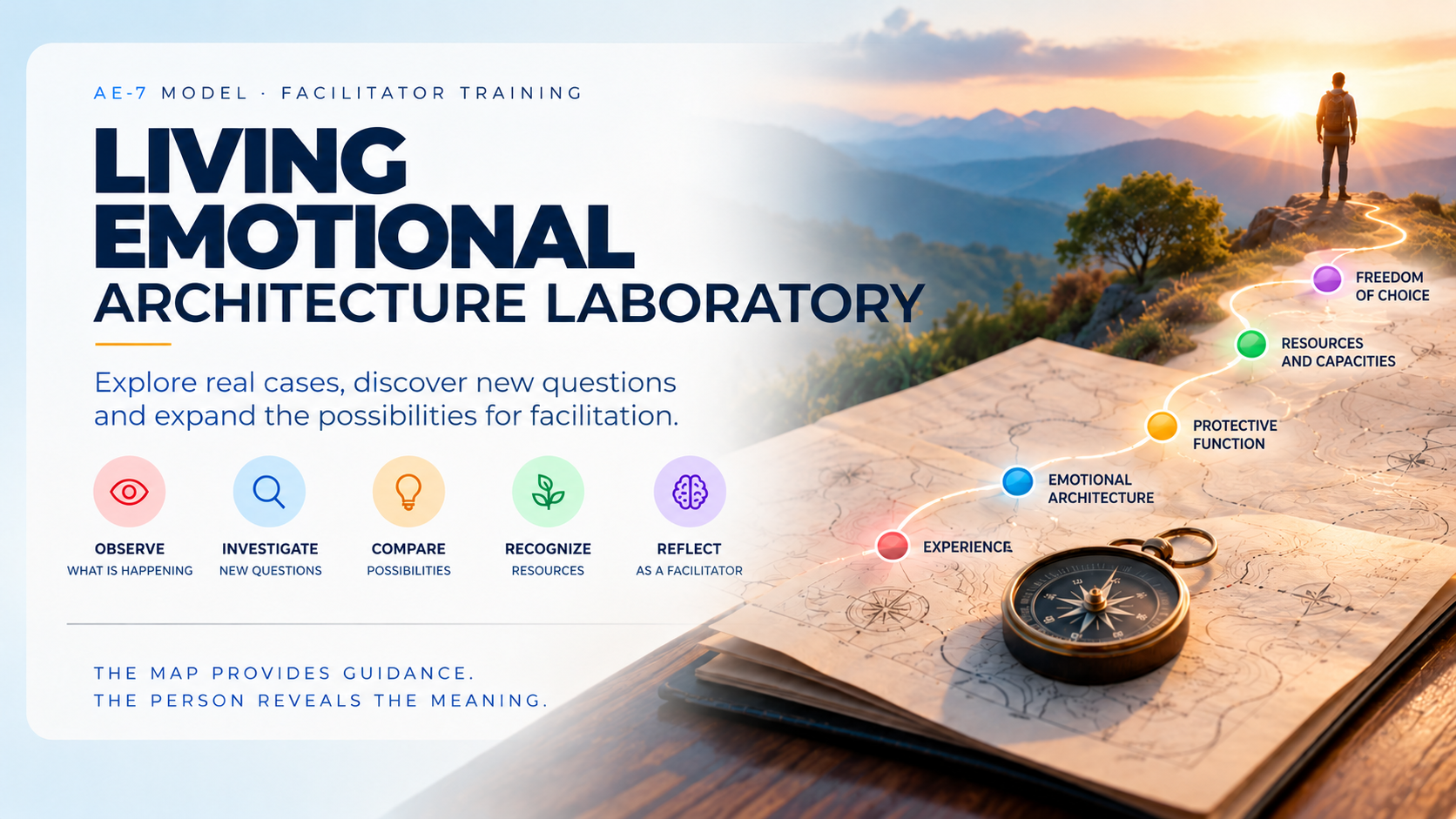
The three free-access cases are the starting point of a broader training journey.
The Advanced Emotional Architecture Laboratory offers a space to deepen your practice of the AE-7 Model through new interactive exercises, comparisons of interventions, and reflection on the facilitator’s role.
It will progressively expand with experiences drawn from the project’s case libraries.
Access restricted to authorized students and users.
ACCESS THE ADVANCED LABORATORY →
BEYOND EMOTIONAL PRISONS: RECOGNIZING RESOURCES
Exploring our emotional architecture does not mean looking only for what limits us.
Our personal history also gives rise to capacities, strengths, learning, and resources that may remain valuable even when the circumstances that helped develop them have changed.
This investigation invites us to distinguish between what we wish to transform, what we can develop, and what we want to preserve.
A CAPACITY CAN BE PRESERVED EVEN WHEN THE OBLIGATION THAT ONCE ACCOMPANIED IT IS NO LONGER NECESSARY.
The questions and analyses are invitations to explore, not diagnoses or definitive conclusions. Their meaning must always be examined in relation to the person’s own experience.
THE MAP PROVIDES GUIDANCE. THE PERSON REVEALS THE MEANING.
CASE LIBRARIES · ACCESS BY CODE
In addition to the three free exercises, Emotional Architect offers 135 additional cases, organized into two libraries for consultation, study, and reflection.
All these cases require an access code.
30 PC CASES · EMOTIONAL ARCHITECTURE
Experiences analyzed through the AE-7 Model to explore possible emotional roots, adaptation strategies, and alternatives for choice.
105 THERAPY CASES · FACILITATION EXPERIENCES
Personal, emotional, and relational situations offering different perspectives on therapeutic processes and possibilities for intervention.
EXPLORE THE 105 THERAPY CASES →
EVERY CASE OPENS NEW QUESTIONS. EVERY QUESTION CAN BROADEN OUR PERSPECTIVE.